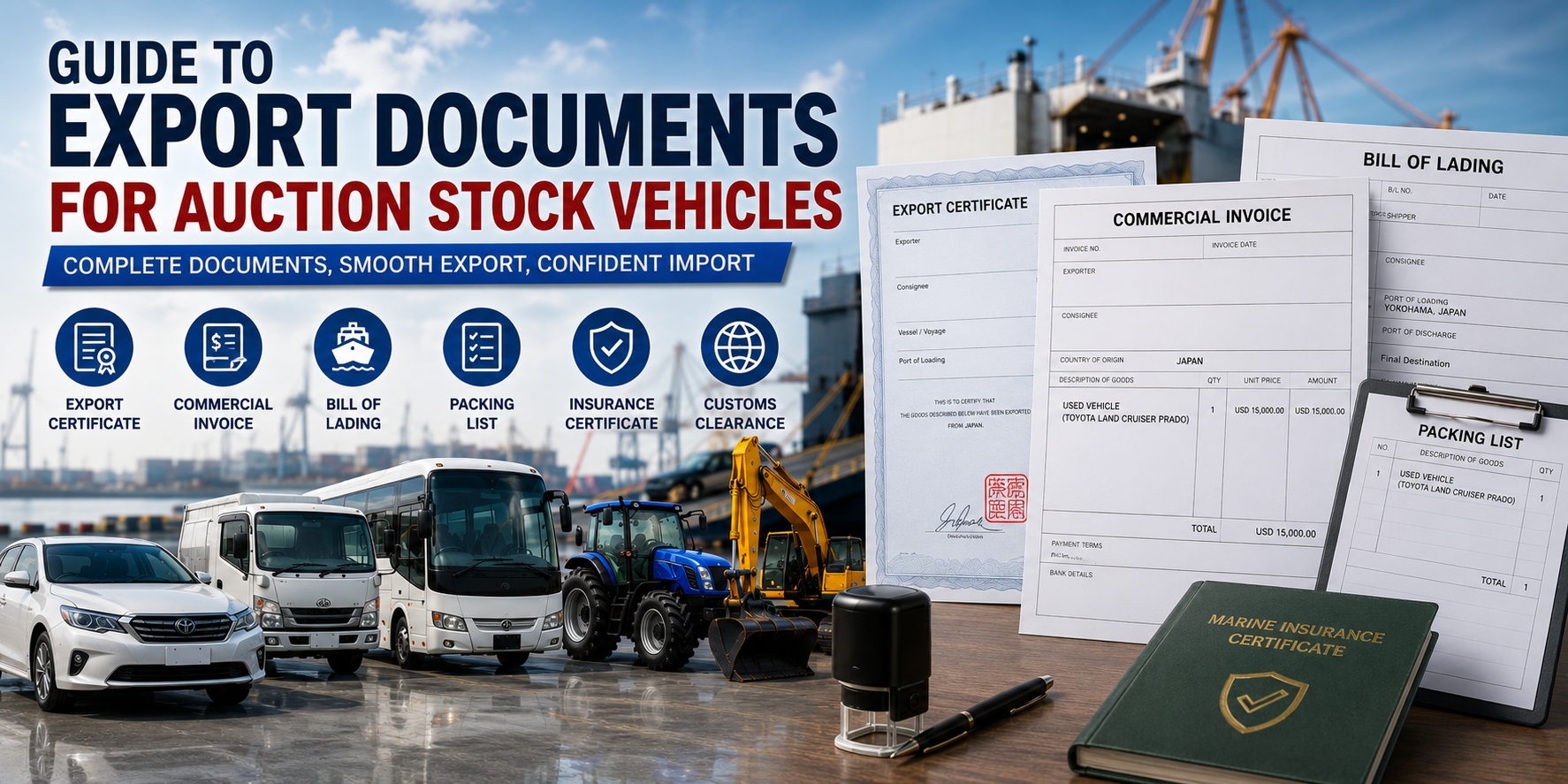
Guide to Export Documents for Auction Stock Vehicles
Buying vehicles from Japan is a practical option for many overseas buyers. Japan offers a large selection of reliable vehicles, clear inspection information, and an organized export process.
However, buying the vehicle is only one part of the process. Export documents are also very important. Without the correct paperwork, customs clearance may be delayed, and the buyer may face extra costs.
This guide explains the main export documents used for Auction Stock Japan vehicles. It is written for overseas buyers who want to import vehicles from Japan with confidence.
Search available auction vehicles here:
Browse Auction Vehicles
Understanding the Japanese Used Vehicle Auction System
Japan has one of the largest used vehicle auction systems in the world. Many auction houses list vehicles every week for dealers, exporters, and professional buyers.
Before a vehicle enters a Japanese vehicle auction, inspectors check its condition and prepare an auction sheet. This report helps buyers understand the vehicle before bidding.
The auction system usually provides:
- Vehicle specifications
- Mileage information
- Auction grade
- Interior condition
- Exterior condition
- Repair marks
- Inspector comments
- Accident history notes
This transparency is one reason Japanese used vehicles are trusted in many export markets.
What Is Auction Stock?
Auction Stock means vehicles that are currently available through Japanese auction houses.
Unlike fixed dealer inventory, Japanese Auction Stock changes every day. New vehicles are listed, sold, and replaced by other vehicles quickly.
Auction Stock Japan includes many vehicle categories:
- Used cars from Japan
- Used trucks from Japan
- Used buses from Japan
- Used tractors from Japan
- Commercial vans
- Forklifts
- Construction machinery
- Agricultural machinery
- Special-purpose vehicles
This wide selection allows buyers to compare many vehicles before making a decision.
Auction Stock vs Dealer Stock
Auction Stock
- Vehicles are sold through bidding
- Inventory changes daily
- Large vehicle selection is available
- Prices reflect market competition
- Auction sheets are available before bidding
Dealer Stock
- Vehicles are already owned by dealers
- Prices are usually fixed
- Immediate purchase is possible
- Inventory is smaller than auctions
- Some vehicles are already export-ready
Both options are useful. Auction Stock is helpful when buyers want more choice. Dealer Stock is useful when buyers want a simpler and faster purchase.
Why Export Documents Matter
Export documents confirm the legal movement of a vehicle from Japan to another country.
These documents are used by shipping companies, customs officers, port agents, and import authorities.
Correct documents help buyers:
- Prove vehicle ownership
- Confirm vehicle identity
- Clear customs smoothly
- Meet local import rules
- Register the vehicle after arrival
- Avoid delays at the destination port
For import businesses, proper paperwork is not optional. It is a key part of the total buying process.
Main Export Documents for Auction Stock Vehicles
Export Certificate
The Export Certificate is one of the most important documents for vehicles exported from Japan.
It is issued after the vehicle is deregistered in Japan. It confirms that the vehicle can be exported.
The Export Certificate usually includes:
- Chassis number
- Vehicle model information
- Engine details
- Registration history
- Owner information
- Vehicle dimensions and weight
Many countries require this document for customs clearance and registration.
English Translation of the Export Certificate
The original Export Certificate is issued in Japanese.
Many overseas buyers request an English translation. This helps customs officers and registration authorities understand the vehicle details.
Commercial Invoice
The Commercial Invoice records the sale between the exporter and the buyer.
It normally includes:
- Buyer name and address
- Exporter information
- Vehicle details
- Purchase price
- Shipping terms
- Invoice date
Customs offices often use this document to calculate duties and taxes.
Bill of Lading
The Bill of Lading is issued by the shipping company after the vehicle is loaded onto the vessel.
It is proof that the vehicle has been shipped. It is also required when the buyer receives the vehicle at the destination port.
Buyers should check the details carefully, including the consignee name, vessel name, port of loading, and port of discharge.
Packing List
A Packing List may be required for container shipments, machinery, spare parts, or vehicles with attachments.
It describes what is inside the shipment.
Insurance Certificate
If marine insurance is arranged, an Insurance Certificate may be issued.
This document explains the insurance coverage during shipping.
Additional Documents Required by Some Countries
Import rules are different in each country. Some destinations may require extra documents before the vehicle can be cleared.
Examples include:
- Pre-shipment inspection certificate
- Roadworthiness certificate
- Emission certificate
- Import permit
- Fumigation certificate
- Local customs declaration forms
Buyers should confirm local requirements before buying and shipping the vehicle.
Documents for Trucks, Buses, Tractors, and Machinery
Commercial vehicles and machinery may need more detailed information than passenger cars.
Used Trucks from Japan
Truck buyers may need documents showing body type, dimensions, weight, and chassis details.
Used Buses from Japan
Bus buyers may need seating capacity, body type, and vehicle size information.
Used Tractors from Japan
Tractor buyers may need serial numbers, engine information, and attachment details.
Machinery
Machinery buyers may need machine serial numbers, weight information, working hour details, and loading documents.
How to Read the Auction Sheet Before Export
Before export documents are prepared, buyers should review the Auction sheet Japan report carefully.
The auction sheet is not an export document, but it is an important buying document.
It helps buyers check:
- Auction grade
- Interior grade
- Mileage
- Repair marks
- Damage diagram
- Rust and corrosion
- Inspector comments
This information helps buyers understand condition before payment and shipping.
Why Photos Should Be Checked Together with Auction Sheets
Auction sheets explain the condition with grades and symbols. Photos show the real appearance of the vehicle.
Buyers should check both before bidding.
Important photo points include:
- Exterior body condition
- Interior condition
- Visible rust
- Truck cargo body
- Bus seats and floor
- Tractor tires and body panels
- Machinery attachments
This helps buyers avoid misunderstandings and buy with confidence.
Benefits of Using Japanese Auction Stock
Many overseas buyers choose Japanese Auction Stock because it offers a wide range of choices.
Key benefits include:
- Large daily inventory
- Transparent inspection reports
- Access to many vehicle types
- Competitive market pricing
- Opportunity to buy direct from Japan
- Many choices for business buyers
These benefits make Japanese auctions useful for importers, dealers, transport companies, farmers, and machinery buyers.
The Typical Purchase and Export Process
The buying and export process usually follows these steps:
- Search Auction Stock Japan listings
- Select vehicles of interest
- Review auction sheets and photos
- Confirm budget and shipping costs
- Place a bid through an exporter
- Win the auction
- Complete payment
- Deregister the vehicle in Japan
- Prepare export documents
- Book shipping
- Send documents to the buyer
- Clear customs at the destination port
A clear process helps buyers understand what happens after winning an auction.
Common Documentation Mistakes to Avoid
- Using incorrect buyer information
- Forgetting country-specific import rules
- Not checking the Bill of Lading details
- Waiting too long to confirm documents
- Assuming all countries require the same paperwork
- Ignoring inspection certificate requirements
- Not keeping copies of all documents
Good preparation reduces risk and avoids unnecessary delays.
Why Use a Professional Export Company?
Export documents can be difficult for first-time buyers. Each country has different requirements, and vehicle types may require different paperwork.
A professional Japanese vehicles exporter can help buyers manage the process correctly.
Professional support may include:
- Vehicle sourcing
- Auction sheet review
- Document preparation
- Shipping arrangement
- Export procedure support
- Guidance for customs paperwork
- Communication with shipping companies
Working with a trusted partner helps buyers reduce mistakes and import vehicles from Japan more smoothly.
Tips for Beginners to Buy with Confidence
First-time buyers should prepare carefully before bidding.
- Check import rules in your country
- Understand the required documents
- Review the auction sheet before bidding
- Check vehicle photos carefully
- Confirm shipping costs in advance
- Keep all document copies
- Use professional support when needed
These steps help beginners buy with confidence and avoid common import problems.
Final Thoughts
Export documents are a key part of buying Japanese used vehicles. They support ownership proof, customs clearance, shipping, and local registration.
Whether you are buying used cars from Japan, used trucks from Japan, used buses from Japan, used tractors from Japan, or machinery, correct paperwork is essential.
EVERY TRADING is a Japanese used vehicle exporter serving customers around the world. The company exports cars, trucks, buses, tractors, machinery, and many other vehicle types.
Buyers can search Japanese Auction Stock and receive professional support throughout the purchasing process. As a trusted Japanese vehicles exporter and trusted partner, EVERY TRADING helps overseas buyers with vehicle checks, export procedures, documentation, and shipping arrangements.
Learn more about Japanese auctions:
Japanese Car Auction Guide
Start searching your vehicle from Japan today:
Search Auction Vehicles Now


Browse Reliable Used Trucks & Buses from Japan
Carefully selected vehicles ready for export worldwide
Search 100,000+ Dealer Stock Vehicles from Japan
Access a wide selection of vehicles from Japanese dealers nationwide. Updated daily.