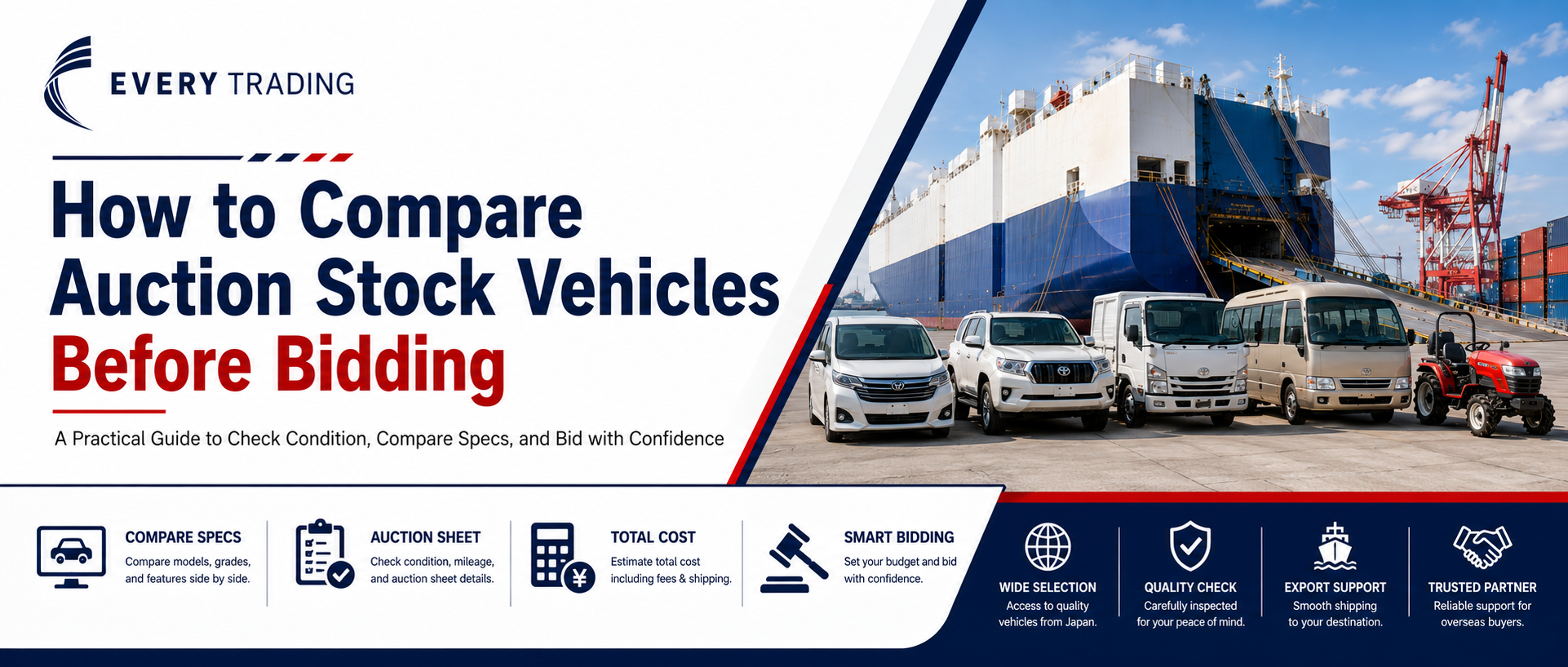
Comparing vehicles before bidding is one of the most important parts of buying from a Japanese vehicle auction. Two vehicles may look similar in photos, yet their condition, specifications, total cost, and resale value can be very different.
Japanese Auction Stock gives overseas buyers access to a large number of Japanese used vehicles. Buyers can search for cars, trucks, buses, tractors, machinery, and special-purpose vehicles. However, a wide selection can also make the final decision more difficult.
Therefore, buyers should use a clear comparison process before placing any bid. The best vehicle is not always the one with the lowest starting price. Instead, it is the vehicle that offers the best balance of condition, cost, business value, and import suitability.
This guide explains how to compare Auction Stock vehicles before bidding. It also covers auction sheets, Dealer Stock, purchase steps, common risks, and professional export support.
For more vehicle reviews and buying guides, visit EVERYCAR REVIEW.
Search available auction vehicles here:
Browse Auction Vehicles
What Is Japanese Auction Stock?
Japanese Auction Stock refers to vehicles listed for sale through professional vehicle auctions in Japan. These auctions are mainly used by licensed dealers, exporters, rental companies, leasing businesses, fleet operators, and finance companies.
The overseas buyer does not usually own the vehicle before the auction. Instead, the buyer searches available listings and chooses a suitable vehicle.
Next, a registered Japanese vehicles exporter or auction agent places a bid on the buyer’s behalf. If the bid is successful, the vehicle is purchased and prepared for export.
If the bid is not successful, the buyer can continue searching. As a result, Auction Stock Japan gives buyers many chances to compare vehicles before making a purchase.
Japanese Auction Stock may include:
- Compact cars, sedans, hatchbacks, hybrids, SUVs, and wagons
- Commercial vans and passenger vans
- Used trucks from Japan, including flatbeds, dump trucks, box trucks, and crane trucks
- Used buses from Japan, including minibuses and larger passenger buses
- Used tractors from Japan for farming and agricultural work
- Construction machinery, forklifts, loaders, excavators, and other equipment
- Special-purpose vehicles for business and public service use
How the Japanese Vehicle Auction System Works
A Japanese vehicle auction is a wholesale market where vehicles are sold through bidding. Sellers send vehicles to an auction house, and the auction house prepares each vehicle for sale.
Vehicle Inspection
Before the auction, an inspector checks the visible condition of the vehicle. The inspector may record scratches, dents, rust, repairs, interior wear, warning lights, and other noticeable issues.
The results are written on an auction sheet. This report helps buyers understand the general condition before bidding.
Vehicle Listing
The listing usually includes the make, model, year, chassis number, mileage, engine size, transmission, fuel type, auction grade, photos, and auction sheet.
Because this information is available before the auction, buyers can compare several vehicles in a structured way.
Bidding
Registered auction members place bids during the auction. The highest bid usually wins if it reaches the seller’s required price.
Since bidding can move quickly, buyers should decide their maximum bid before the auction starts.
Payment and Export Preparation
After a successful bid, the buyer pays the vehicle price and related costs. Then, the exporter arranges collection, inland transport, export documents, customs procedures, and shipping.
Japanese Auction Stock vs Dealer Stock
Buyers can source Japanese used vehicles through Auction Stock or Dealer Stock. Both options can be useful. However, they work in different ways.
Auction Stock
Auction Stock is purchased through bidding. The final price is not fixed before the auction.
Also, the buyer may not win the first vehicle selected. For this reason, Auction Stock is best for buyers who have time to search and compare.
The main advantage is selection. Japanese vehicle auctions often list many models, years, mileage ranges, and conditions.
Dealer Stock
Dealer Stock is usually already owned by a dealer or exporter. The price is normally fixed.
In addition, the vehicle may be available for immediate purchase. This can be useful when the buyer needs a faster decision.
Main Differences
- Price: Auction Stock prices are decided by bidding, while Dealer Stock usually has a fixed price.
- Selection: Auctions often provide a wider and more frequently changing vehicle range.
- Speed: Dealer Stock may be faster for urgent purchases.
- Availability: Auction vehicles may be purchased by another bidder.
- Condition information: Auction Stock usually includes an auction sheet.
- Planning: Auction Stock is useful when buyers can search early.
Many professional buyers use both sources. Auction Stock can help find specific vehicles. Meanwhile, Dealer Stock can help fill urgent needs.
Benefits of Comparing Japanese Auction Stock
Better Control Over Vehicle Quality
When buyers compare several vehicles, they can avoid choosing a vehicle only because its price looks attractive.
For example, one vehicle may have lower mileage but more body damage. Another vehicle may have higher mileage but a cleaner auction sheet and better service history.
Therefore, a careful comparison can help buyers choose better overall value.
More Suitable Vehicles for Local Demand
Buyers can compare model codes, engine sizes, fuel types, transmissions, and body styles. As a result, they can select vehicles that match local customer demand.
This is important when importing used cars from Japan, used trucks from Japan, used buses from Japan, used tractors from Japan, or machinery.
Lower Risk of Unexpected Costs
A vehicle with a low auction price may need expensive repairs after arrival. However, a cleaner vehicle may be ready for use or resale sooner.
By comparing condition and total cost, buyers can reduce the risk of unexpected expenses.
More Confidence Before Bidding
A clear comparison process helps buyers set a realistic maximum bid. In addition, it reduces emotional bidding during the auction.
How to Compare Auction Stock Vehicles Before Bidding
Compare the Vehicle Purpose
First, decide how the vehicle will be used. A family car, delivery van, dump truck, school bus, tractor, and excavator all have different requirements.
For business buyers, the vehicle must match the job. Therefore, buyers should compare practical value, not only appearance.
Compare Model Codes and Specifications
Vehicles with the same model name may have different model codes, engines, transmissions, drive systems, and equipment.
For example, one SUV may be two-wheel drive, while another is four-wheel drive. Likewise, two trucks may have different payloads or body sizes.
Before bidding, compare:
- Model code
- Engine size and fuel type
- Transmission type
- Two-wheel drive or four-wheel drive
- Body dimensions
- Payload or seating capacity
- Equipment and attachments
- Local spare parts availability
Compare Year and Mileage
Year and mileage are important, but they should not be reviewed alone. A newer vehicle may have heavy use, while an older vehicle may have lower mileage and better care.
Therefore, buyers should compare year, mileage, condition, and maintenance history together.
Compare Auction Grades
The auction grade gives a general view of vehicle condition. Higher grades often suggest cleaner vehicles. Lower grades may show more wear, repairs, or damage.
However, buyers should not choose a vehicle only because it has a higher grade. Two vehicles with the same grade may have very different condition notes.
Compare the Auction Sheet
An Auction sheet Japan report is one of the most important tools for comparison. It shows the inspector’s comments, vehicle diagram, grades, and basic details.
When comparing auction sheets, look for:
- Exterior scratches, dents, and paint marks
- Rust or corrosion
- Previous repairs
- Interior stains, tears, or odors
- Warning lights or engine noise
- Oil leaks or other visible problems
- Missing parts or damaged equipment
Because auction sheet comments are often written in Japanese, buyers should request a clear explanation before bidding.
Compare Photos Carefully
Photos can help confirm body condition, interior condition, wheels, tires, seats, and equipment.
Still, photos have limits. Small damage, rust, oil leaks, and mechanical problems may not be easy to see.
For this reason, buyers should use photos together with the auction sheet, not as a replacement for it.
Compare Total Landed Cost
The auction price is only one part of the total cost. Buyers should calculate the full landed cost before bidding.
The total may include:
- Auction purchase price
- Auction and exporter fees
- Inland transport in Japan
- Export documents
- Ocean freight
- Marine insurance
- Import duties and taxes
- Port and clearance charges
- Repairs and maintenance
- Registration and local delivery
A lower-priced vehicle may become more expensive after repairs. Therefore, buyers should compare total cost, not only the bid price.
Comparison Points for Different Vehicle Types
Cars and SUVs
Used cars from Japan should be compared by fuel economy, mileage, model popularity, engine size, spare parts, and resale value.
For SUVs, buyers should also compare ground clearance, drive system, tire condition, and road suitability.
Commercial Vans
Commercial vans should be compared by cargo space, seating layout, roof height, door condition, and engine size.
In addition, buyers should check whether the van will be used for cargo, passengers, or both.
Trucks
Used trucks from Japan require careful comparison. Buyers should check payload, body type, body dimensions, chassis rust, engine type, and hydraulic equipment.
For dump trucks, crane trucks, and refrigerated trucks, the condition of the special equipment is also important.
Buses
Used buses from Japan should be compared by seating capacity, interior condition, air conditioning, door layout, and passenger transport rules.
A bus with a clean interior may be more valuable than a cheaper bus that needs major repairs.
Tractors
Used tractors from Japan should be compared by operating hours, hydraulic systems, tire condition, engine performance, and attachments.
Moreover, buyers should confirm whether parts and service support are available locally.
Machinery
Machinery should be compared by operating hours, hydraulic condition, attachments, tracks or tires, and visible leaks.
Since machinery is more technical, buyers may need extra checks beyond the auction sheet.
The Purchasing Process
The process to buy direct from Japan through auction usually follows several clear steps.
- Choose a trusted exporter. Work with a company that has access to Japanese auctions and international shipping experience.
- Define your vehicle needs. Explain the vehicle type, budget, destination, condition, and intended use.
- Search auction listings. Select several vehicles that match your requirements.
- Compare specifications. Review model codes, engines, transmissions, dimensions, and equipment.
- Check auction sheets. Compare grades, damage marks, mileage, and inspector comments.
- Calculate total costs. Include fees, shipping, taxes, and expected repairs.
- Set a maximum bid. Decide the highest acceptable price before bidding starts.
- Place the bid. The exporter bids through the Japanese vehicle auction.
- Complete payment. After a successful bid, pay the required amount within the specified time.
- Arrange export and shipping. Prepare documents and delivery plans before the vehicle arrives.
Important Risks and Points to Check
- Auction sheets are condition reports, not full mechanical warranties.
- Some defects may not appear in photos or inspection comments.
- Vehicles are normally sold in their current condition.
- Winning bids usually cannot be canceled without penalties.
- Freight, taxes, and import charges can change the total cost.
- Older vehicles may require repairs after arrival.
- Special vehicles may need extra documents or inspections.
- Rare models may be difficult to repair or resell.
- Machinery and commercial vehicles may need extra technical checks.
Therefore, buyers should avoid bidding when important condition information is unclear. They should also avoid vehicles that do not meet local import rules.
Why Professional Export Support Matters
Using a professional export company can make vehicle comparison easier and safer.
A reliable Japanese vehicles exporter can help buyers search listings, understand auction sheets, compare vehicles, place bids, arrange payment, and manage export procedures.
This support is especially important for trucks, buses, tractors, and machinery. These vehicles often have more technical details than passenger cars.
A trusted partner can also help confirm shipping methods, vehicle dimensions, port rules, destination requirements, and export documents.
Professional support does not remove every risk. However, it can help buyers make better decisions and avoid common mistakes.
Tips for Beginners to Buy with Confidence
- Compare at least three suitable vehicles before bidding.
- Choose common models with local demand.
- Check model codes and specifications carefully.
- Read the auction sheet and ask questions.
- Set a total landed-cost budget, not only a bid limit.
- Confirm local spare parts and maintenance support.
- Avoid vehicles with unclear condition notes.
- Do not increase the bid above the planned limit.
- Check import rules before purchasing.
- Work with an exporter that explains costs clearly.
Beginners can buy with confidence when they compare vehicles carefully, follow clear buying rules, and use professional support.
Frequently Asked Questions
Should buyers choose the vehicle with the lowest mileage?
Not always. Low mileage is useful, but buyers should also compare condition, age, repairs, and total cost.
Is a higher auction grade always better?
A higher grade often suggests cleaner condition. However, buyers should review the full auction sheet before making a decision.
Can buyers compare cars, trucks, buses, tractors, and machinery?
Yes. Japanese Auction Stock includes many vehicle types. However, each category needs a different comparison method.
Is Auction Stock always cheaper than Dealer Stock?
No. Auction prices depend on bidding. Therefore, buyers should compare the full landed cost.
Can first-time buyers use Japanese auctions?
Yes. First-time buyers can use Japanese auctions through a registered exporter or auction agent.
How EVERY TRADING Supports Overseas Buyers
EVERY TRADING is a Japanese used vehicle export company that supplies customers around the world. The company handles many types of Japanese used vehicles, including cars, trucks, buses, tractors, machinery, and commercial vehicles.
Overseas buyers can search Japanese auction vehicles and compare available options based on their business needs.
EVERY TRADING provides professional support to help customers purchase vehicles from Japan with greater confidence.
As a trusted Japanese vehicles exporter, EVERY TRADING supports buyers with pre-purchase checks, auction sheet confirmation, export procedures, documentation, inland transport, and shipping arrangements.
This support can help buyers reduce uncertainty, choose suitable vehicles, and prepare for a smoother import process.
Learn more about Japanese auctions:
Japanese Car Auction Guide
Start searching your vehicle from Japan today:
Search Auction Vehicles Now
Conclusion
Comparing Auction Stock vehicles before bidding can help buyers make safer and more profitable decisions. Japanese auctions offer cars, vans, trucks, buses, tractors, machinery, and other vehicles for many different needs.
However, successful buying requires more than checking the starting price. Buyers should compare specifications, auction sheets, photos, total costs, import rules, and local demand.
By working with a trusted partner and using Japanese Auction Stock carefully, overseas buyers can import vehicles from Japan and buy with confidence.


Browse Reliable Used Trucks & Buses from Japan
Carefully selected vehicles ready for export worldwide
Search 100,000+ Dealer Stock Vehicles from Japan
Access a wide selection of vehicles from Japanese dealers nationwide. Updated daily.