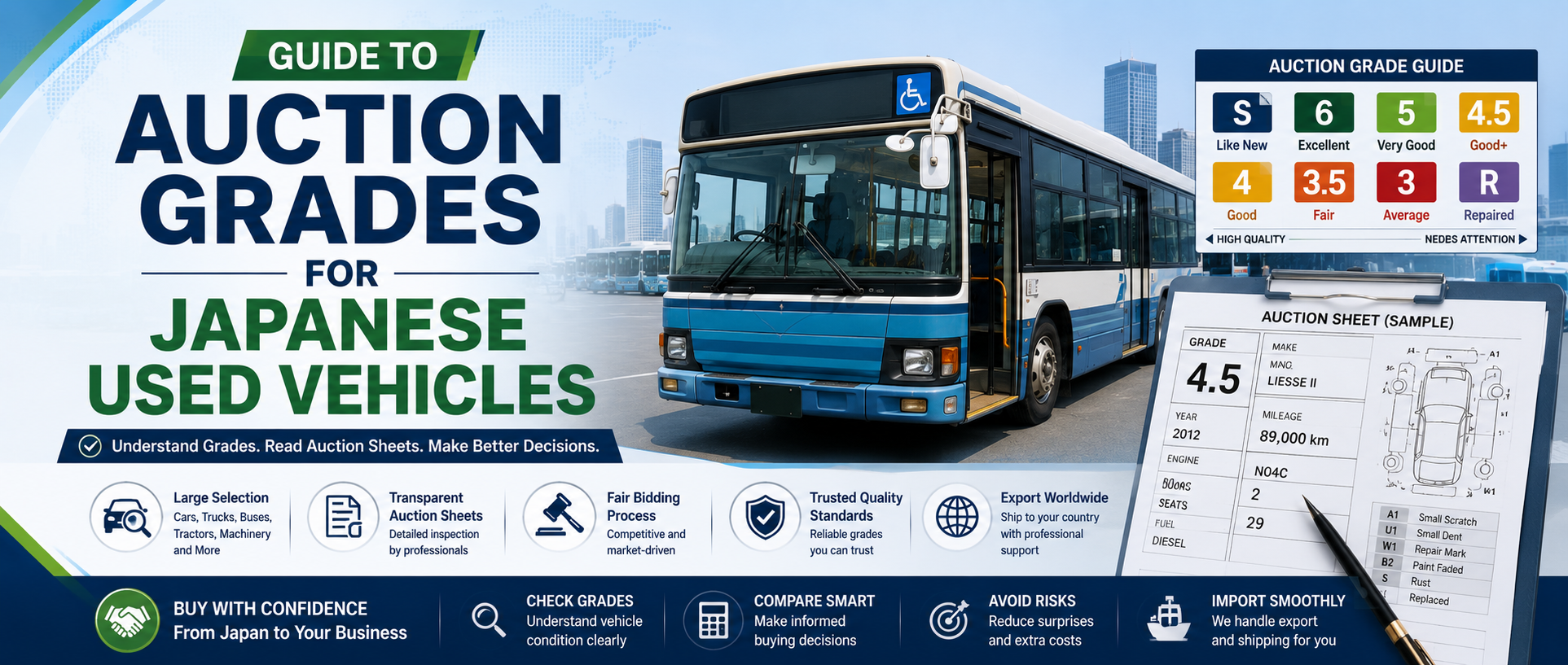
Guide to Auction Grades for Japanese Used Vehicles
Auction grades are one of the most important points to understand when buying Japanese used vehicles through auctions.
For overseas buyers, auction grades help explain the general condition of a vehicle before bidding.
Search available auction vehicles here:
Browse Auction Vehicles
This guide explains how Japanese auction grades work, what Auction Stock Japan means, how to read an Auction sheet Japan, and how buyers can avoid common mistakes when importing vehicles from Japan.
How Japanese Vehicle Auctions Work
A Japanese vehicle auction is a professional marketplace where used vehicles are sold through bidding.
Vehicles are listed by dealers, leasing companies, transport companies, farms, construction companies, rental companies, and private owners.
Before the auction, inspectors check each vehicle and prepare an auction sheet.
This sheet includes useful information such as auction grade, mileage, repair history, damage marks, interior condition, and inspector comments.
Most overseas buyers cannot join Japanese vehicle auctions directly. Therefore, they usually work with a Japanese vehicles exporter that has auction access.
What is Auction Stock Japan?
Auction Stock Japan means vehicles listed in Japanese auction systems and available for bidding.
Japanese Auction Stock changes every day. New vehicles enter the market regularly, so buyers can compare many choices.
Auction Stock may include:
- Used cars from Japan
- Used trucks from Japan
- Used buses from Japan
- Used tractors from Japan
- Construction machinery
- Commercial vans
- Forklifts and industrial equipment
- Special purpose vehicles
Because many vehicle types are available, auction grades help buyers compare condition quickly.
Auction Stock vs Dealer Stock
Auction Stock
Auction Stock vehicles are sold through bidding.
The final price depends on demand, condition, mileage, grade, and competition from other buyers.
Auction Stock Japan gives buyers access to a large number of vehicles and market-based pricing.
Dealer Stock
Dealer Stock vehicles are already owned by dealers and sold at fixed prices.
Dealer Stock is often easier for beginners because the price is clear and the buying process is simple.
However, Auction Stock often provides a wider selection, especially for buyers looking for specific cars, trucks, buses, tractors, or machinery.
What Are Japanese Auction Grades?
Japanese auction grades are condition ratings given by auction inspectors.
They help buyers understand the general quality of a vehicle before bidding.
However, buyers should remember one important point: the grade is only a summary.
The full auction sheet, photos, damage map, and inspector comments must also be checked carefully.
Common Japanese Auction Grades
Grade S
Grade S usually means the vehicle is almost new or very close to new condition.
These vehicles often have very low mileage and excellent condition.
Grade 6
Grade 6 usually means a very high-quality used vehicle with low mileage and very clean condition.
These vehicles often attract strong bidding.
Grade 5
Grade 5 means the vehicle is in very good condition.
It may have small signs of use, but it is generally clean and attractive.
Grade 4.5
Grade 4.5 means the vehicle is in good condition with some minor wear.
Many overseas buyers consider this grade a strong balance between quality and price.
Grade 4
Grade 4 is common in Japanese auctions.
It usually means the vehicle has normal used condition with some scratches, dents, or wear.
Grade 3.5
Grade 3.5 means the vehicle may have more visible wear, scratches, dents, or repair needs.
These vehicles may still be useful, but buyers should check the auction sheet carefully.
Grade 3
Grade 3 vehicles usually have noticeable wear or condition issues.
They may be suitable for buyers who accept repairs or lower cosmetic condition.
Grade R or RA
Grade R or RA usually means the vehicle has repair history.
This does not always mean the vehicle is bad, but buyers must understand the repair details before bidding.
Interior and Exterior Grades
Many auction sheets also include interior and exterior condition ratings.
These ratings may use letters such as A, B, C, D, or E.
Interior Grade
Interior grade shows the condition of seats, dashboard, floor, ceiling, smell, stains, and general cabin wear.
For used buses from Japan, interior condition is especially important because passengers will use the vehicle.
Exterior Grade
Exterior grade shows the body condition, paint condition, scratches, dents, and visible damage.
For used trucks from Japan, buyers should also check the body equipment, chassis, and cargo area.
How to Read an Auction Sheet Japan
Auction Grade
The auction grade shows the general condition of the vehicle.
It is useful, but it should never be the only decision point.
Mileage or Operating Hours
Cars, trucks, and buses usually show mileage.
Used tractors from Japan and machinery may show operating hours instead of mileage.
Lower mileage or lower hours may increase value, but maintenance condition is also important.
Damage Map
The damage map shows scratches, dents, rust, paint marks, repairs, and other body condition points.
Buyers should check the damage map carefully, especially for commercial vehicles and machinery.
Inspector Comments
Inspector comments may mention oil leaks, engine noise, rust, accident history, interior damage, hydraulic problems, or missing parts.
These comments should be translated and explained clearly before bidding.
Why Auction Grades Are Useful for Overseas Buyers
They Help Compare Vehicles Quickly
Auction grades help buyers compare many vehicles in a short time.
This is useful when checking large numbers of Japanese Auction Stock listings.
They Support Better Budget Planning
Higher-grade vehicles usually cost more.
Lower-grade vehicles may cost less, but they may need repairs or cleaning.
They Improve Transparency
Auction grades and auction sheets give buyers more information before bidding.
This helps overseas buyers make better decisions even when they cannot inspect vehicles in person.
Important Cautions About Auction Grades
Grades Can Vary by Auction House
Different auction houses may have slightly different inspection standards.
A Grade 4 vehicle at one auction may not always match a Grade 4 vehicle at another auction.
Photos Are Still Important
Photos help confirm the actual appearance of the vehicle.
Buyers should check photos together with the auction sheet.
Repair History Must Be Checked Carefully
A repaired vehicle may still be usable, but buyers must understand the repair area and quality.
This is especially important for resale businesses.
Low Grade Does Not Always Mean Bad Value
Some lower-grade vehicles may still be useful for work, parts, or business use.
However, buyers should understand the risks before bidding.
How to Buy from Japanese Auction Stock
Step 1: Decide Vehicle Requirements
Buyers should decide the vehicle type, budget, grade range, mileage, model, and destination country rules.
Step 2: Search Auction Stock Japan
Buyers can search by brand, model, year, mileage, auction grade, body type, and auction date.
Step 3: Review the Auction Sheet
The Auction sheet Japan should be checked carefully before bidding.
A professional exporter can help explain condition details clearly.
Step 4: Set a Safe Bid Budget
Buyers should calculate the total cost before bidding.
This includes auction price, inland transport, export fees, shipping, customs duty, local taxes, and inspection costs.
Step 5: Place a Bid Through an Exporter
The exporter places the bid during the Japanese vehicle auction.
If the bid wins, the purchase process begins.
Step 6: Arrange Export and Shipping
After purchase, the vehicle moves to a port or storage yard.
The exporter prepares documents, arranges shipping, and supports communication until the vehicle leaves Japan.
Why Use a Professional Japanese Vehicles Exporter?
Understanding auction grades can be difficult for beginners.
A professional Japanese vehicles exporter helps buyers read auction sheets, compare grades, understand condition, and set a safe bid.
Professional support may include:
- Auction vehicle search
- Auction sheet translation
- Auction grade explanation
- Vehicle condition advice
- Market price guidance
- Bidding support
- Export document preparation
- Shipping arrangement
This professional support helps buyers buy direct from Japan with confidence.
A trusted partner can also help buyers compare Auction Stock and Dealer Stock based on budget, schedule, and business purpose.
Beginner Tips to Buy with Confidence
- Do not judge a vehicle only by the auction grade.
- Always check the full auction sheet.
- Review photos and damage maps carefully.
- Ask about repair history before bidding.
- Calculate total cost before setting a bid.
- Confirm import rules in your country.
- Use a trusted Japanese vehicles exporter.
Beginners should focus on condition, reliability, total cost, and long-term value.
Conclusion
Auction grades are a helpful tool for understanding Japanese used vehicles, but they are only one part of the buying decision.
Buyers should also check auction sheets, photos, mileage, damage maps, inspector comments, import rules, and total costs.
Through Japanese Auction Stock, overseas buyers can search used cars from Japan, used trucks from Japan, used buses from Japan, used tractors from Japan, machinery, and many other vehicle types.
Working with a trusted partner and using professional support helps buyers avoid mistakes and buy with confidence.
EVERY TRADING is a Japanese used vehicles exporter that exports Japanese used vehicles to customers around the world.
EVERY TRADING handles cars, trucks, buses, tractors, machinery, and many other vehicle categories.
The company provides Japanese auction vehicle search and professional support so overseas buyers can safely import vehicles from Japan.
As a trusted Japanese vehicles exporter, EVERY TRADING supports buyers before purchase, during export procedures, and until shipment from Japan.
Learn more about Japanese auctions:
Japanese Car Auction Guide
Start searching your vehicle from Japan today:
Search Auction Vehicles Now


Browse Reliable Used Trucks & Buses from Japan
Carefully selected vehicles ready for export worldwide
Search 100,000+ Dealer Stock Vehicles from Japan
Access a wide selection of vehicles from Japanese dealers nationwide. Updated daily.