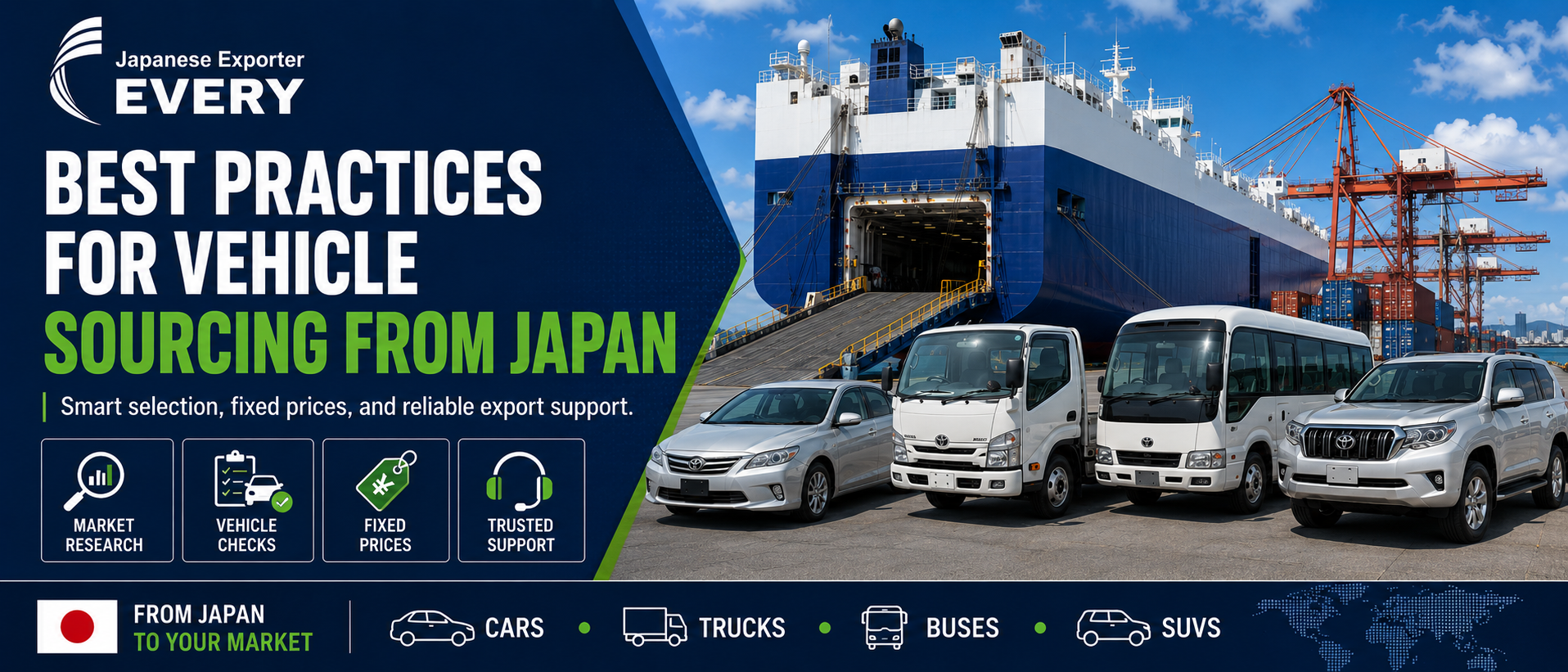
Best Practices for Vehicle Sourcing from Japan
Best Practices for Vehicle Sourcing from Japan are important for overseas buyers who want to import used vehicles with confidence. Many importers, dealers, companies, and business owners in Africa, the Caribbean, Asia, and other regions choose Japan because Japanese used vehicles are known for quality, reliability, and strong resale value.
Vehicle sourcing is not only about finding a low price. Buyers must choose the right vehicle type, check the condition, understand the total cost, confirm documents, and plan export. A good sourcing process can help reduce risk and improve business results.
Dealer stock is one of the simplest ways to source vehicles from Japan. Vehicles are already available, prices are usually fixed, and export preparation can start quickly after confirmation. Buyers can review available Japanese dealer stock vehicles and compare suitable cars, trucks, buses, vans, tractors, and commercial vehicles for their market.
Choose Vehicles Based on Market Demand
The first best practice is to choose vehicles based on real market demand. A vehicle may be popular in Japan, but it must also fit the needs of your local customers. Business buyers should think about what people and companies in their country actually need.
For example, compact cars may sell well in markets where fuel cost is important. Sedans may be good for taxi business, office use, or private buyers. SUVs may be useful in rural areas or countries with rough roads. Vans can support delivery, airport transfer, school transport, and small business.
Trucks are important for construction, logistics, farming, and delivery. Light-duty trucks are useful for small companies and city delivery. Medium-duty and heavy-duty trucks can support larger business operations. Buses are useful for schools, hotels, churches, tour companies, and passenger transport businesses.
Tractors and machinery may be important in agricultural markets. In farming areas, a reliable used tractor can support land preparation, food production, and rural business growth. These buyers may care more about horsepower, working condition, and parts support than appearance.
Before buying, importers and dealers should study their local market. Check which models sell quickly, which engine sizes are preferred, which brands have strong parts support, and which vehicle types can bring good profit after import.
This market-first approach helps buyers avoid slow-moving stock. It also helps them build trust with local customers because they can offer vehicles that match real needs.
Compare Dealer Stock and Auction Options
Another best practice is to understand the difference between dealer stock and auction vehicles. Both can be useful, but they are not the same. The best choice depends on your buying style, budget, and timing.
Japanese vehicle auctions offer many choices. Experienced buyers may use auctions to search for special models or price opportunities. However, auctions also have uncertainty. The final price is not fixed until bidding ends. The buyer may spend time checking a vehicle and still lose the bid.
Dealer stock is different. The vehicle is already available for sale. The price is usually fixed or clearly shown. This makes the buying process easier to understand, especially for buyers who need quick decisions.
For business buyers, fixed prices are a big advantage. Importers and dealers need to calculate total cost and resale price before they buy. If the purchase price is not clear, profit planning becomes difficult.
Dealer stock also supports faster export. Since the vehicle is ready, the buyer can confirm the unit, complete payment, and start export preparation more quickly. This is helpful when buyers need vehicles for a sales season, a business project, or customer orders.
Buyers who want speed, trust, and simplicity may prefer dealer stock. Buyers who have more time and auction experience may use auctions as part of their sourcing strategy. For many overseas buyers, a balanced approach can also work.
Check Vehicle Details and Total Cost Carefully
Safe vehicle sourcing from Japan requires careful checking. Buyers should review the vehicle information before making a final decision. This includes model year, mileage, chassis code, engine type, transmission, fuel type, body type, photos, and condition.
For cars, buyers should check exterior condition, interior condition, fuel economy, and local resale demand. For trucks, loading capacity, body type, chassis condition, tire condition, and engine condition are important. For buses and vans, seating capacity and interior condition matter. For tractors, buyers should check horsepower, working hours, tires, hydraulics, PTO, and attachments when available.
Buyers should also think about parts and maintenance. A vehicle with a famous brand may be easier to maintain if parts are available locally. A rare model may be difficult to repair after arrival, even if the price is attractive.
Total cost is also very important. The vehicle price is only one part of the full cost. Buyers should consider inland transport in Japan, export fees, ocean freight, inspection fees if needed, import duty, port charges, local repair, and registration.
Dealer stock helps with cost planning because the vehicle price is usually clear from the beginning. This makes it easier to calculate landed cost and business profit. You can compare current used vehicles from Japan dealer stock to review prices and vehicle types before sending an inquiry.
Checking these points before purchase can reduce mistakes. It also helps buyers choose vehicles that are easier to sell, easier to use, and better for long-term business.
Work with a Trusted Exporter for Smooth Sourcing
Professional support is one of the most important parts of vehicle sourcing from Japan. Overseas buyers cannot always visit Japan to inspect vehicles, confirm documents, or manage shipping. This is why a trusted exporter is valuable.
A professional exporter can help buyers understand the vehicle details, price, payment process, documents, shipping method, and export schedule. Clear communication reduces confusion and helps buyers make decisions with more confidence.
Documents are especially important in vehicle export. Buyers may need an invoice, export certificate, bill of lading, inspection certificate, and other papers depending on the destination country. If documents are wrong or missing, the vehicle may face delays after arrival.
Shipping also needs careful planning. Cars, trucks, buses, vans, tractors, and machinery may need different shipping methods. Some vehicles are shipped by RoRo vessel. Others may need container shipping. The best method depends on destination, size, condition, and schedule.
EVERY supports overseas buyers who want to source used vehicles from Japan. The company handles cars, trucks, buses, vans, tractors, and commercial vehicles for many markets. This experience helps buyers choose suitable stock and plan export more smoothly.
For buyers who want to learn more about buying direct from Japan, this Japanese dealer stock vehicles guide explains how dealer stock can support faster and simpler vehicle sourcing.
Long-term relationships are also important. When an exporter understands your market, budget, destination port, and preferred vehicle types, future sourcing becomes faster and more accurate. This helps importers and dealers grow with more stable supply.
Conclusion
Best Practices for Vehicle Sourcing from Japan begin with good planning. Buyers should study market demand, compare vehicle types, check condition, understand total cost, and work with a trusted exporter.
Dealer stock can make sourcing faster and simpler. Vehicles are ready to buy, prices are usually fixed, and export preparation can start quickly. This helps overseas buyers reduce uncertainty and plan their business with more confidence.
For importers, dealers, companies, and business owners in Africa, the Caribbean, Asia, and other growing markets, Japanese used vehicles can support real business growth. With the right sourcing strategy and professional support, buyers can choose reliable cars, trucks, buses, vans, tractors, and commercial vehicles from Japan more safely and successfully.


Browse Reliable Used Trucks & Buses from Japan
Carefully selected vehicles ready for export worldwide
Search 100,000+ Dealer Stock Vehicles from Japan
Access a wide selection of vehicles from Japanese dealers nationwide. Updated daily.