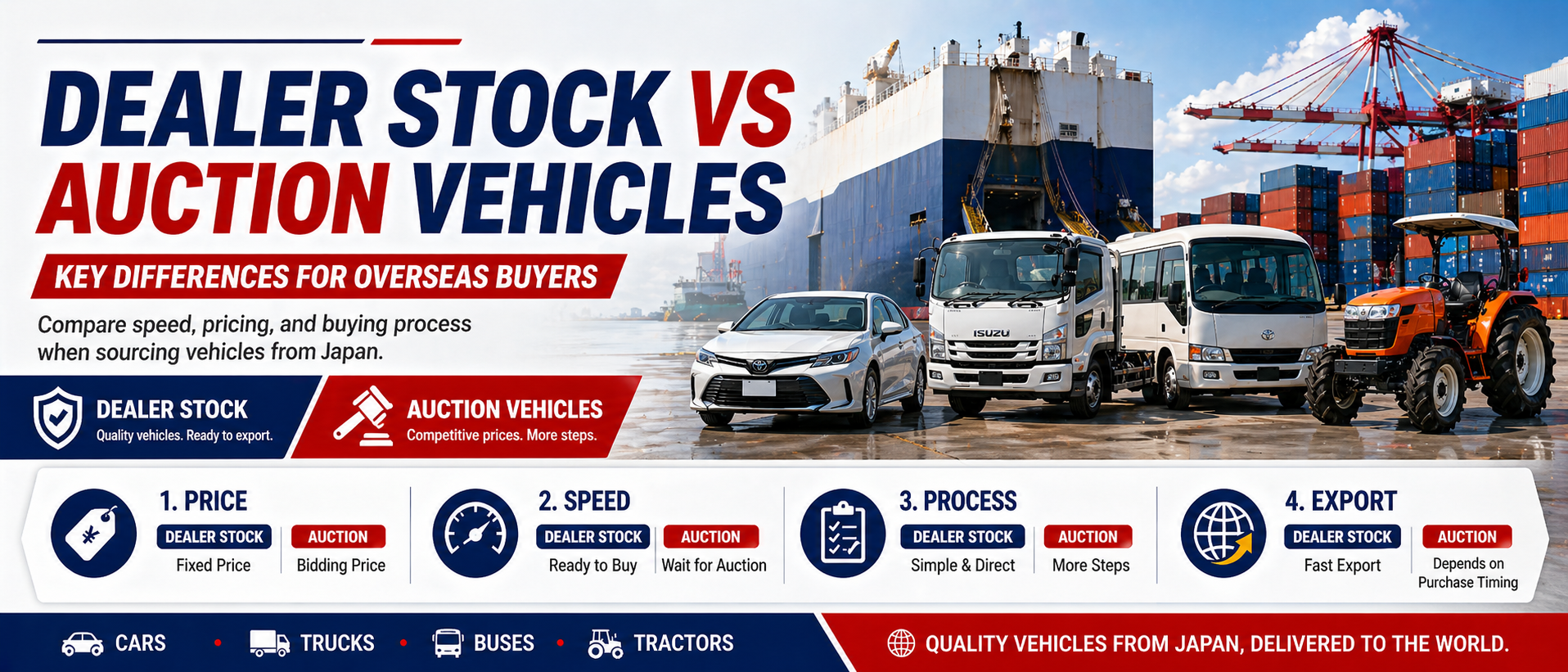
Dealer Stock vs Auction Vehicles: Key Differences for Overseas Buyers
Dealer Stock vs Auction Vehicles: Key Differences for Overseas Buyers is an important topic for anyone who wants to buy used vehicles from Japan. Many overseas buyers can choose from dealer stock vehicles or auction vehicles. Both options are useful, but they work in different ways.
Dealer stock means vehicles that are already available for direct purchase. The price is usually fixed, and the buyer can make a quick decision. Auction vehicles are sold through a bidding system. The buyer can place a bid, but the final result depends on other bidders and the auction price.
For importers, dealers, companies, and business buyers in Africa, the Caribbean, Asia, and other regions, the best choice depends on the purpose. Some buyers need speed and clear pricing. Some buyers want a wider selection and are willing to wait. Understanding the difference helps buyers choose the right way to buy cars, trucks, buses, vans, tractors, and other used vehicles from Japan.
1. What Is Dealer Stock?
Dealer stock vehicles are used vehicles that are already listed for sale by dealers, exporters, or trusted suppliers in Japan. These vehicles are not waiting for auction bidding. They are already available, so buyers can check them and move forward quickly.
This is one of the biggest benefits of dealer stock. The buyer can see the listed price before making a decision. This makes it easier to calculate the total budget, including the vehicle price, export cost, freight, port charges, and import duty in the destination country.
Dealer stock is especially useful for buyers who need speed. For example, a car dealer may need vehicles quickly for resale. A transport company may need a used bus for passenger service. A construction company may need a used truck for work. A farmer may need a tractor for daily operations.
Because the vehicle is already available, the buying process can be simple. The buyer checks the vehicle, confirms details, receives a quotation, makes payment, and starts the export process. This simple flow is useful for buyers who want to reduce stress and avoid the uncertainty of bidding.
Buyers who want to start with ready-to-buy options can check available Japanese dealer stock vehicles and compare cars, trucks, buses, and tractors from Japan.
2. What Are Auction Vehicles?
Auction vehicles are used vehicles sold through auction systems in Japan. Japan has a large used vehicle auction market. Many vehicles are listed every week, including passenger cars, commercial trucks, buses, vans, SUVs, and sometimes machinery.
The main feature of auctions is bidding. Buyers do not buy the vehicle at a fixed price. Instead, they place a bid. If the bid is successful, they can purchase the vehicle. If another bidder offers more, they may lose the vehicle.
This system can be useful for buyers who want access to many options. Auctions can offer a wide range of models, years, mileage levels, grades, and conditions. Buyers who are searching for a specific model may find more choices through auctions.
However, auctions also require more experience. The buyer needs to understand auction grades, inspection sheets, bidding limits, auction dates, and market prices. The final price is not always clear before the auction ends. This can make planning more difficult, especially for first-time buyers.
Another point is timing. Even if a buyer finds a good vehicle, they may not win the bid. They may need to search again and wait for another suitable unit. For buyers who need a vehicle quickly, this can be a challenge.
3. Main Differences Between Dealer Stock and Auction Vehicles
The first major difference is price. Dealer stock usually has a fixed price. The buyer can see the price before making a decision. Auction vehicles do not have a final price until bidding ends. This means the buyer may need to adjust the budget depending on the result.
The second difference is speed. Dealer stock can be faster because the vehicle is already available for direct purchase. If the buyer agrees with the price and condition, the process can move forward quickly. Auction vehicles may take more time because the buyer must wait for the auction date and bidding result.
The third difference is simplicity. Dealer stock is easier for many overseas buyers to understand. The buyer checks the vehicle, asks questions, confirms the cost, and proceeds. Auctions involve more steps, and buyers may need stronger support to avoid mistakes.
The fourth difference is selection. Auctions usually offer a larger number of vehicles. This can be good for buyers who want many choices or are looking for a rare model. Dealer stock may have fewer units, but the available vehicles are easier to compare and purchase quickly.
The fifth difference is risk. In auctions, the buyer may face price changes, bidding competition, or misunderstanding of the vehicle condition. In dealer stock, the buyer can focus on available vehicles with shown prices and direct communication. This can reduce uncertainty.
For buyers who want a simple and practical route, used vehicles from Japan dealer stock can be a strong option because the process is clear and direct.
4. Which Option Is Better for Overseas Buyers?
The better option depends on the buyer’s business needs. Dealer stock is often better for buyers who value speed, fixed pricing, and simple communication. It is suitable when the buyer needs to purchase quickly and prepare for export without waiting for auction results.
Dealer stock is also useful for first-time buyers. The process is easier to understand. Buyers can ask questions, compare vehicles, and confirm the total cost before moving forward. This helps reduce confusion and builds trust.
Auction vehicles may be better for buyers who want a wider selection. If the buyer is searching for a specific model, special grade, or certain condition, auctions may provide more chances. However, the buyer must understand that the final price and purchase result are not guaranteed.
For business buyers, the decision should be based on time, budget, and purpose. A dealer who needs quick resale stock may choose dealer stock. A company that has time to search for a very specific truck may use auctions. A buyer who needs a bus, van, or tractor urgently may prefer dealer stock because it can support faster export planning.
Professional support is also important. Buying from Japan requires more than choosing a vehicle. Buyers need help with vehicle details, invoice, payment process, export documents, shipping, and communication. EVERY supports overseas buyers by helping them source suitable vehicles and move forward with more confidence.
For more information about buying directly from Japan, buyers can read the Japanese dealer stock vehicles guide. It is useful for understanding dealer stock, auctions, export steps, and vehicle sourcing from Japan.
Conclusion
Dealer Stock vs Auction Vehicles: Key Differences for Overseas Buyers can be explained in a simple way. Dealer stock is direct, fast, and clear. Auction vehicles offer many choices, but the process can take more time and the final price is not fixed until bidding ends.
For overseas buyers who need speed, trust, and simplicity, dealer stock is often a practical choice. The vehicle is available, the price is usually fixed, and the export process can start faster after purchase confirmation.
For buyers who want a very wide selection and are comfortable with bidding, auctions can also be useful. However, they require more knowledge and careful decision-making.
EVERY helps overseas buyers choose the best route based on their needs. Whether buyers are looking for cars, trucks, buses, vans, tractors, or other used vehicles from Japan, the right sourcing method can make the purchase safer, faster, and easier.


Browse Reliable Used Trucks & Buses from Japan
Carefully selected vehicles ready for export worldwide
Search 100,000+ Dealer Stock Vehicles from Japan
Access a wide selection of vehicles from Japanese dealers nationwide. Updated daily.