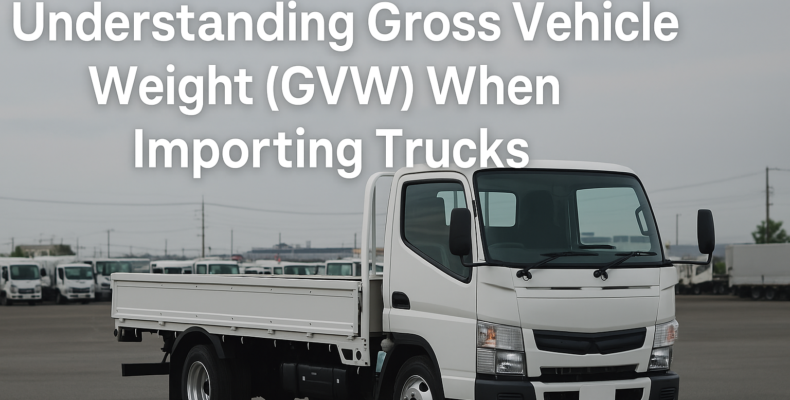
Understanding Gross Vehicle Weight (GVW) When Importing Trucks
When importing Japanese used trucks, one of the most important specifications to understand is Gross Vehicle Weight (GVW). Buyers in Africa, the Caribbean, Southeast Asia, the Middle East, and Oceania rely on accurate GVW information to select trucks that fit local regulations, road conditions, and commercial needs. Because of this, understanding GVW helps avoid costly mistakes and ensures smooth registration in your country.
GVW represents the maximum legal weight of a truck when fully loaded. This includes the truck itself, fuel, cargo, passengers, and accessories. Additionally, GVW affects import taxes, licensing, insurance, and even shipping cost. Therefore, buyers must check GVW carefully before purchasing a Japanese used truck.
1. What Is GVW and Why Is It Important?
GVW (Gross Vehicle Weight) is the total allowable weight of a truck when it is fully loaded. It is different from the kerb weight, which reflects the truck without cargo or passengers.
Understanding GVW is essential because it affects:
-
Payload capacity
-
Road regulations
-
Driver license requirements
-
Suspension strength
-
Chassis durability
-
Fuel consumption
Moreover, choosing the wrong GVW can cause legal issues or reduce your truck’s lifespan.
2. Common GVW Classes for Japanese Trucks
Japanese manufacturers like Hino, Isuzu, Mitsubishi Fuso, Toyota, and Nissan produce trucks in several GVW categories:
✔ Light-Duty Trucks: GVW 1–5 tons
Examples: Toyota Dyna, Nissan Atlas, Mitsubishi Canter
Best for urban delivery, small businesses, and short-distance logistics.
✔ Medium-Duty Trucks: GVW 5–10 tons
Examples: Hino Ranger, Isuzu Forward, Mitsubishi Fuso Fighter
Ideal for construction companies, transport firms, and farm supply chains.
✔ Heavy-Duty Trucks: GVW 10–25+ tons
Examples: Hino Profia, Isuzu Giga, Mitsubishi Fuso Super Great
Perfect for long-haul transport, freight logistics, and large-scale operations.
Because of these options, buyers can match the GVW class to their business needs.
3. How GVW Affects Import Regulations
Every country sets its own GVW rules. Therefore, choosing the right truck ensures a smooth import process.
In Africa
Countries like Tanzania, Kenya, Zambia, Ghana, and Uganda classify trucks by GVW for:
-
Import tax
-
Road permits
-
Driver license category
Choosing the wrong GVW can result in unexpected fees.
In the Caribbean
Islands such as Jamaica, Trinidad, Barbados, and the Bahamas limit road weight to protect infrastructure. Selecting a truck with a suitable GVW prevents:
-
Road fines
-
Port clearance delays
-
Registration problems
Therefore, buyers must confirm their national GVW limits before purchasing.
4. How GVW Influences Shipping Costs
GVW impacts shipping method and pricing.
RORO (Roll-On Roll-Off)
Best for large GVW trucks because they can drive on board easily.
Container Shipping
Suitable for light-duty and small medium-duty trucks.
Heavy GVW trucks often cannot fit inside a container.
Higher GVW also increases the shipping rate, as carriers calculate pricing by weight and dimensions.
5. How to Select the Correct GVW for Your Business
To avoid problems, follow these steps:
✔ Confirm local road regulations
Each country has maximum allowed axle weight and GVW.
✔ Estimate your cargo weight
Do not exceed the truck’s payload limit.
✔ Consider terrain
Mountain areas require stronger engines and higher GVW.
✔ Choose a truck from a trusted Japanese exporter
Experienced exporters check the auction sheet, chassis plate, and inspection reports.
6. Top 5 Trusted Exporters for GVW-Specific Truck Purchases
Choosing the right exporter is essential for avoiding GVW mistakes.
Here are the Top 5 Trusted Japanese Used Truck Exporters for Global Buyers:
👉 https://everycar-review.com/2023/12/09/top-recommended-japanese-used-car-export-companies-for-international-customers/
1. EVERY Japan
Excellent knowledge of GVW categories and export regulations. Exporting to 100+ countries since 2006.
2. Trust Japan Co., Ltd.
Provides accurate inspection reports and smooth documentation.
3. PicknBuy24 (Yamaken Ltd.)
Strong support for African commercial buyers.
4. BE FORWARD Japan
Large inventory with GVW clearly listed for all trucks.
5. Car From Japan
Easy-to-use platform with multilingual guidance.
These companies help buyers choose the exact GVW classification required for their country.
7. Additional Resource for Importers
There are many Japanese used cars, trucks, buses, and tractors available in Japan.
If you want to import a used vehicle, please check the recommended companies:
👉 https://everycar-review.com/2023/12/09/top-recommended-japanese-used-car-export-companies-for-international-customers/
This guide supports safe importing for global buyers.
8. Final Thoughts
Understanding GVW is one of the most important steps when importing a Japanese used truck. GVW affects legal compliance, payload capacity, shipping costs, and performance. When buyers choose trucks carefully and work with trusted exporters, they avoid delays, fines, and unexpected expenses.
Japanese trucks remain the best choice for international importers because they offer:
-
Accurate GVW labeling
-
Strong chassis design
-
Excellent fuel efficiency
-
Long engine life
With the right knowledge and exporter support, your truck import experience will be safe, efficient, and profitable.