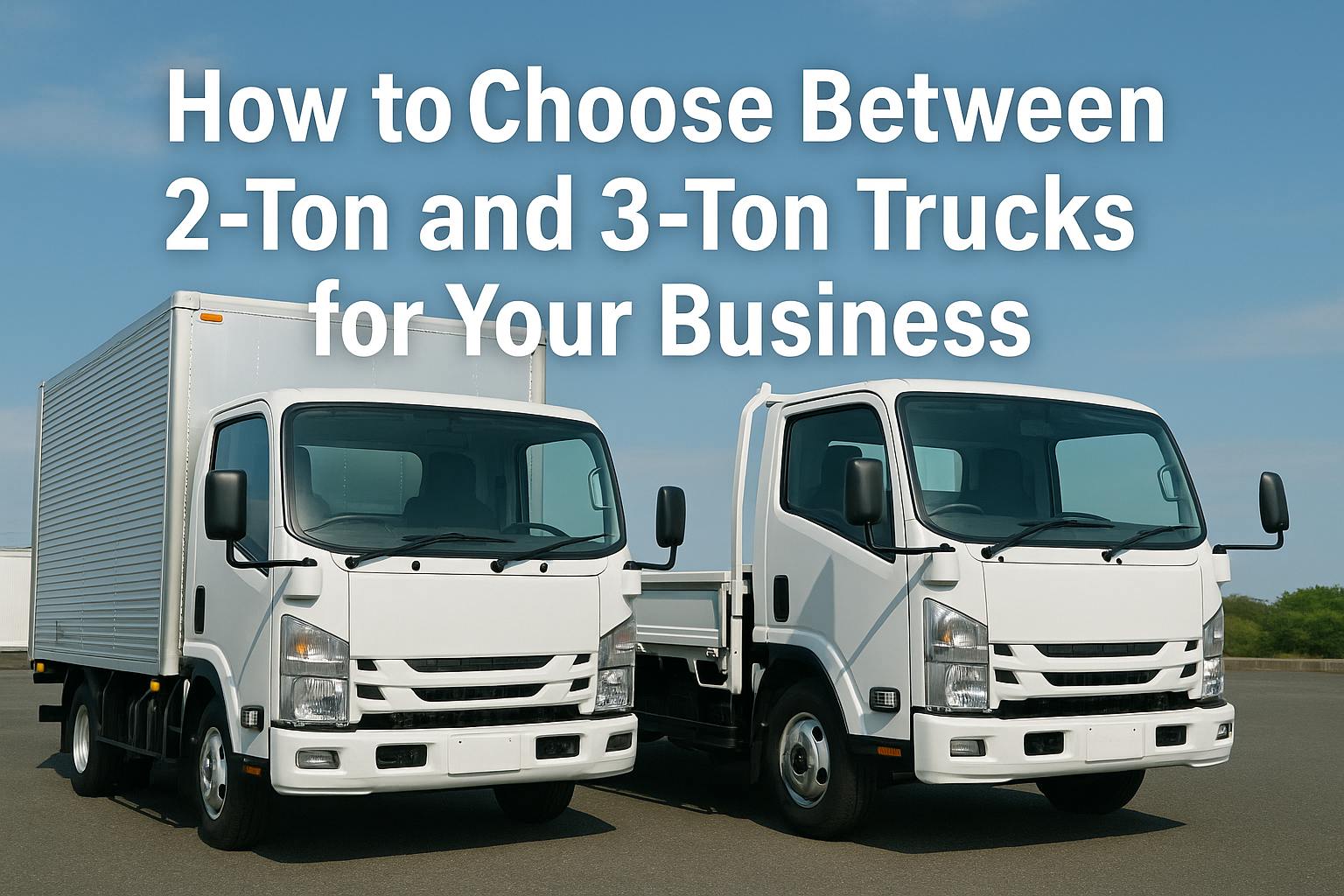
Choosing the right truck size influences your daily operations, fuel cost, and overall profits. Many global buyers compare 2-ton trucks and 3-ton trucks, yet they often feel unsure which size fits their business best.
Fortunately, the differences are clear once you focus on payload, usage, terrain, and long-term cost.
Both truck classes are popular in export markets because Japanese brands deliver high reliability, low maintenance costs, and excellent durability. This guide explains each category in simple steps, helping you make a confident decision.
1. Understand the Key Strengths of 2-Ton Trucks
A 2-ton truck is compact, highly efficient, and easy to operate.
It remains popular in urban logistics, delivery services, construction support, agriculture, and light transport operations.
Major Advantages
-
Lower fuel consumption
-
Easy maneuvering in tight streets
-
Lower purchase price
-
Ideal for short-distance delivery
-
Cheaper parts and maintenance
Additionally, 2-ton trucks fit well in countries with narrow roads or dense traffic, such as many African and Asian cities.
Common Models
-
Toyota Dyna 2t
-
Isuzu Elf 2t
-
Mitsubishi Canter 2t
These models offer strong engines despite their compact size.
2. Why Many Buyers Choose 3-Ton Trucks
A 3-ton truck provides more power and a heavier payload capacity.
It is ideal for businesses that transport construction materials, agricultural goods, machinery, or large cargo.
Major Advantages
-
Higher payload capacity
-
More durable chassis
-
Stronger engine performance
-
Better for long-distance or mixed terrain
-
Suitable for heavy commercial work
Although fuel use is higher than a 2-ton truck, the added capacity often brings more profit per trip.
Popular Models
-
Isuzu Forward 3t
-
Mitsubishi Fuso 3t
-
Toyota Dyna 3t (heavy-duty version)
These trucks work well even in challenging environments.
3. Compare Payload and Real Cargo Needs
Choosing between the two sizes begins with your actual business needs.
Ask yourself:
-
What is your average cargo weight?
-
Do you transport heavy materials often?
-
Do you work mainly in cities or mixed terrain?
-
Do you plan to expand your operations soon?
If your cargo often exceeds 2 tons, a 3-ton truck is safer and more cost-effective.
However, for frequent city deliveries, the 2-ton size remains more efficient.
4. Consider Fuel Efficiency and Running Costs
Fuel cost affects your long-term profit.
2-ton trucks generally use less fuel because of their smaller engines.
3-ton trucks burn more fuel, yet provide more power for difficult tasks.
Therefore, choose based on your daily route and typical load weight.
5. Evaluate Road Conditions in Your Country
Many buyers overlook terrain, but it matters greatly.
-
Urban areas: 2-ton trucks perform best
-
Rural areas: 3-ton trucks handle rough roads better
-
Mountain regions: 3-ton trucks offer safer torque and braking
-
High-traffic cities: 2-ton trucks move quickly and park easily
Matching the truck to your environment increases safety and efficiency.
6. Understand Long-Term Maintenance
Generally:
-
2-ton trucks → cheaper parts, simpler repair
-
3-ton trucks → stronger parts, slightly higher cost
However, Japanese trucks last long when maintained correctly.
Moreover, engines from Hino, Isuzu, Mitsubishi Fuso, and Toyota are famous worldwide for durability.
7. Check Local Market Demand and Resale Value
In many African and Middle Eastern markets:
-
3-ton trucks often have higher resale value
-
2-ton trucks sell faster because of high demand in delivery businesses
Therefore, knowing your market helps you make a smarter investment.
8. Always Work With a Trusted Exporter
Your exporter determines how safely and smoothly your truck arrives.
A reliable exporter provides:
-
Full inspection reports
-
Clear photos and videos
-
Transparent pricing
-
Professional shipping support
To help you choose safely, refer to this guide:
👉 Top 5 Trusted Japanese Used Truck Exporters for Global Buyers
https://everycar-review.com/2025/07/14/top-5-trusted-japanese-used-truck-exporters-for-global-buyers/
A trustworthy partner ensures you receive the right truck for your business.
Conclusion
Both 2-ton and 3-ton trucks offer excellent value.
A 2-ton truck suits light delivery, city routes, and fuel-efficient operations.
A 3-ton truck suits heavier loads, rural routes, and long-distance transport.
By understanding your cargo weight, road conditions, and budget, you can select the perfect option and improve your business performance.