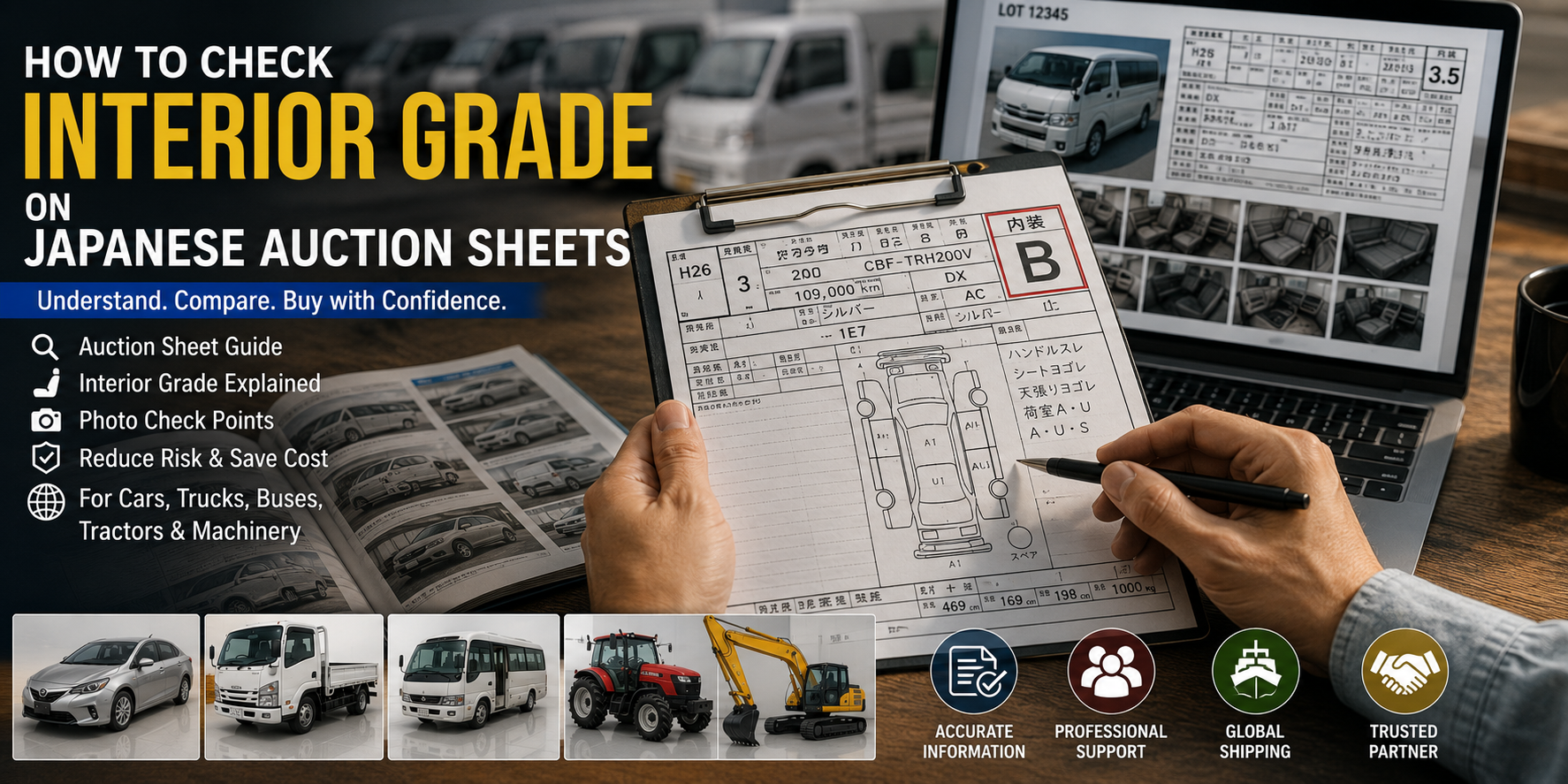
How to Check Interior Grade on Japanese Auction Sheets
When overseas buyers search Japanese used vehicles, the auction sheet is one of the most important documents to check before bidding.
It gives useful details about condition, mileage, repair history, exterior damage, and interior grade.
For buyers who want to import vehicles from Japan, understanding the interior grade helps reduce risk. It also helps buyers choose cars, trucks, buses, tractors, and machinery with more confidence.
Search available auction vehicles here:
Browse Auction Vehicles
What Is a Japanese Vehicle Auction?
A Japanese vehicle auction is a dealer-only marketplace where used vehicles are sold through bidding.
These auctions are not usually open to private overseas buyers. A Japanese vehicles exporter or auction member is normally needed to access the auction system and place bids.
Japanese vehicle auction stock can include many vehicle types.
- Used cars from Japan
- Used trucks from Japan
- Used buses from Japan
- Used tractors from Japan
- Vans and pickups
- Forklifts and construction machinery
- Agricultural machinery
This wide selection is one reason why Auction Stock Japan is popular with importers, dealers, and business buyers around the world.
What Is Auction Stock Japan?
Auction Stock Japan means vehicles listed in Japanese auction systems.
These vehicles may come from dealers, leasing companies, rental companies, companies, farms, transport operators, and trade-in sources.
Japanese Auction Stock is useful because buyers can compare many vehicles in one place. They can check model, year, mileage, grade, photos, and auction sheet details before bidding.
However, Auction Stock is different from normal dealer stock. Buyers should understand the difference before purchase.
Auction Stock vs Dealer Stock
Auction Stock
Auction Stock is sold through a bidding system. The final price depends on competition at the auction.
It may offer many choices and competitive pricing, but buyers must decide quickly. They must also check the auction sheet carefully before bidding.
Dealer Stock
Dealer Stock is already owned by a dealer or exporter. The price is usually fixed or easier to confirm.
Dealer Stock can be easier for beginners because the vehicle is already available for direct purchase.
Main Differences
- Auction Stock uses bidding.
- Dealer Stock usually has a fixed price.
- Auction Stock may offer more choices.
- Dealer Stock can be easier and faster to buy.
- Auction Stock needs careful auction sheet checking.
Why Interior Grade Matters
The interior grade shows the condition of the cabin or operator area.
For passenger cars, it shows seat wear, dashboard condition, stains, smells, and general cleanliness.
For trucks and buses, it can show how much the vehicle was used for business. For tractors and machinery, it may show the condition of the seat, controls, cabin, and operator area.
Interior grade is important because it affects resale value, customer impression, comfort, and repair cost.
Common Interior Grades on Japanese Auction Sheets
Different auction houses may use slightly different systems. However, many auction sheets use interior grades such as A, B, C, D, or E.
Interior Grade A
Grade A usually means the interior is very clean.
There may be very small signs of use, but the cabin is generally in excellent condition.
Interior Grade B
Grade B usually means good interior condition.
There may be light wear, small stains, or minor marks, but the interior is still attractive.
Interior Grade C
Grade C means average used condition.
There may be visible wear, stains, small tears, dashboard marks, or dirt. Many business vehicles fall into this range.
Interior Grade D
Grade D means the interior needs attention.
There may be heavy stains, tears, strong wear, damage, or possible odor. Buyers should check photos and comments carefully.
Interior Grade E
Grade E means poor interior condition.
The vehicle may need cleaning, repairs, replacement parts, or major interior work.
How to Read the Interior Section on an Auction Sheet
Auction sheet Japan information can look difficult for beginners. Many sheets are written in Japanese and use symbols or short comments.
The interior grade is usually shown near the overall grade or condition area. It may be listed as “Interior,” “Int,” or by a letter grade.
Buyers should also check written comments because the letter grade does not explain everything.
Common Interior Issues
- Seat wear
- Seat tears
- Dashboard cracks
- Stains
- Pet hair
- Tobacco smell
- Dirty floor mats
- Missing parts
- Broken switches
- Interior panel damage
If the vehicle is for resale, these points are very important. A clean interior can make the vehicle easier to sell.
Interior Grade for Cars
For used cars from Japan, interior grade is one of the first points buyers should check.
A clean interior improves customer trust. It also helps dealers display the vehicle better after arrival.
For family cars, hybrid cars, SUVs, and luxury vehicles, buyers should pay close attention to seat condition, dashboard condition, stains, and odor comments.
Interior Grade for Trucks
Used trucks from Japan are often bought for business use. Some wear is normal.
However, heavy cabin damage can show hard use. Buyers should check the driver seat, dashboard, steering wheel, floor, and cabin panels.
For commercial trucks, mechanical condition is very important, but interior condition still affects comfort and resale value.
Interior Grade for Buses
Used buses from Japan need careful interior checks because passengers use the cabin every day.
Seat condition, aisle condition, floor condition, curtains, air conditioning vents, and odor are important.
For school transport, tourism, hotel shuttle, or staff transport, a clean bus interior can create a better impression.
Interior Grade for Tractors and Machinery
Used tractors from Japan and machinery may not use the same interior grading style as passenger cars.
However, the operator area is still important. Buyers should check the seat, cabin glass, control levers, dashboard, pedals, and floor.
For cabin tractors, a clean operator area can improve comfort and long working use.
Benefits of Japanese Auction Stock for Overseas Buyers
Japanese Auction Stock offers many benefits for overseas buyers.
- Large stock volume
- Many vehicle categories
- Clear auction sheet information
- Photos before bidding
- Access to cars, trucks, buses, tractors, and machinery
- Competitive market pricing
- Fast vehicle search
- Useful data for comparison
Buyers can compare many vehicles before deciding. This helps them buy direct from Japan with better information.
Purchase Flow from Japanese Auction Stock
Step 1: Decide Your Vehicle Type
First, decide what type of vehicle you need.
- Car for resale or private use
- Truck for logistics or construction
- Bus for passenger transport
- Van for delivery
- Tractor for farming
- Machinery for business use
Step 2: Search Auction Stock
A trusted partner in Japan can search auction stock by maker, model, year, mileage, grade, fuel type, body type, and budget.
Step 3: Check the Auction Sheet
Check the auction sheet Japan details carefully. Look at overall grade, interior grade, mileage, repair history, exterior marks, and inspector comments.
Step 4: Confirm Photos
Photos should match the auction sheet. For interior condition, check seats, dashboard, floor, cargo area, cabin, and operator space.
Step 5: Confirm Total Cost
The auction price is not the final cost. Buyers should confirm auction fee, exporter fee, inland transport, inspection, shipping, insurance, and import charges.
Step 6: Place a Bid
After checking the vehicle and setting a maximum budget, the exporter places the bid.
Step 7: Export and Shipping
If the bid is successful, the exporter arranges payment confirmation, inland transport, export documents, inspection, and shipping.
Important Points Before Bidding
Interior grade is useful, but it should not be the only point you check.
Buyers should also review the full auction sheet, exterior condition, engine comments, rust, mileage, model code, and import rules.
Key Warnings
- A clean interior does not always mean good mechanical condition.
- A low interior grade may still be acceptable for work vehicles.
- Photos can hide stains or odor.
- Japanese comments may need translation.
- Some vehicles need cleaning after arrival.
Why Use a Professional Export Company?
A professional Japanese vehicles exporter helps overseas buyers understand auction sheets and avoid mistakes.
Most auction sheets are written in Japanese. A professional exporter can explain grades, comments, damage marks, and risk points in simple English.
This professional support is especially useful for beginners who want to buy with confidence.
Exporter Support Can Include
- Auction stock search
- Auction sheet translation
- Interior grade explanation
- Vehicle photo review
- Bidding support
- Total cost calculation
- Export document preparation
- Shipping arrangement
Tips for Beginners to Buy with Confidence
- Start with popular Japanese models.
- Check both photos and auction sheet.
- Ask about interior grade before bidding.
- Confirm import rules in your country.
- Set a clear maximum budget.
- Use a trusted partner in Japan.
- Do not buy only because the price is low.
- Check parts availability in your market.
These steps help beginners import vehicles from Japan with less confusion and lower risk.
EVERY TRADING and Japanese Auction Support
EVERY TRADING is a Japanese used vehicles exporter. The company exports Japanese used vehicles to customers around the world.
EVERY TRADING handles many vehicle types, including cars, trucks, buses, tractors, and machinery.
Overseas buyers can search Japanese auction vehicles online and review available Auction Stock Japan options.
As a trusted Japanese vehicles exporter, EVERY TRADING provides professional support before purchase, during export procedures, and through shipping arrangements.
This support helps overseas buyers understand Japanese Auction Stock and buy with confidence.
Learn more about Japanese auctions:
Japanese Car Auction Guide
Start searching your vehicle from Japan today:
Search Auction Vehicles Now


Browse Reliable Used Trucks & Buses from Japan
Carefully selected vehicles ready for export worldwide
Search 100,000+ Dealer Stock Vehicles from Japan
Access a wide selection of vehicles from Japanese dealers nationwide. Updated daily.