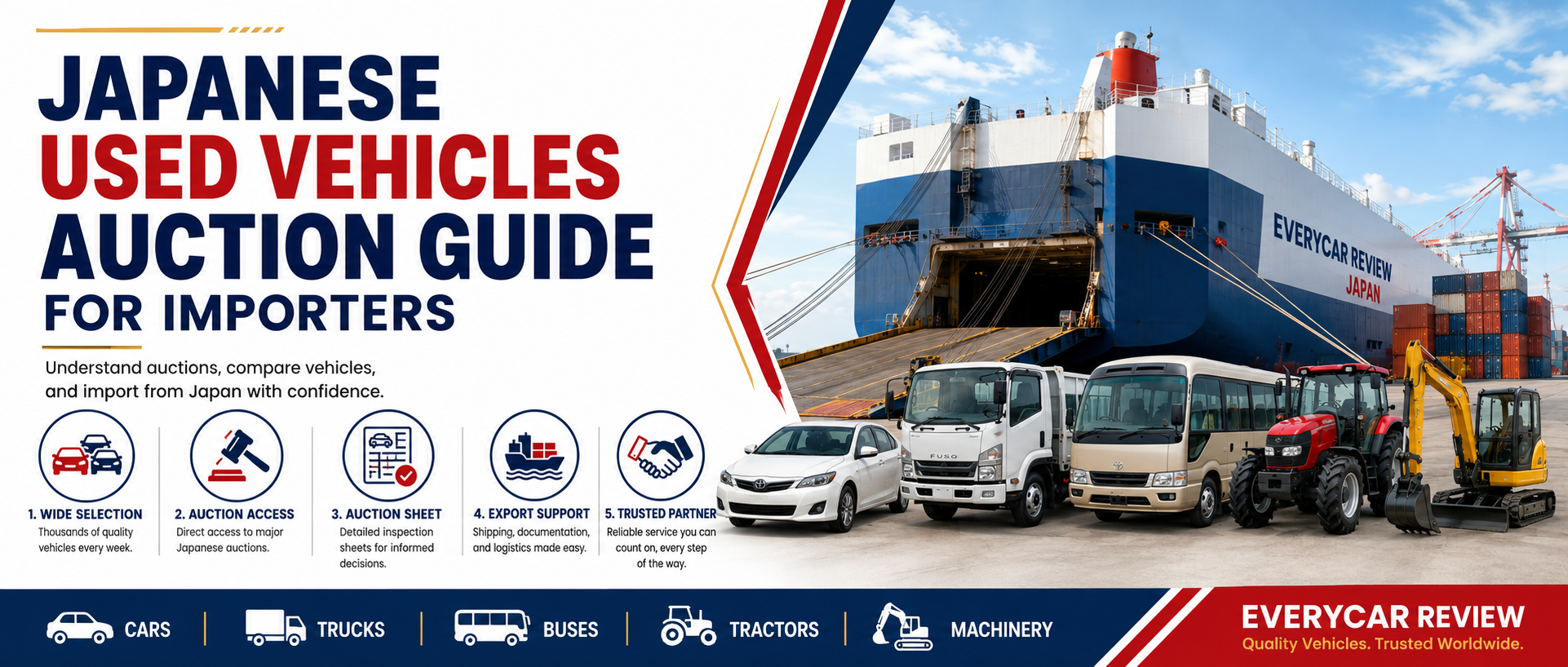
Japanese Used Vehicles Auction Guide for Importers
Search available auction vehicles here:
Browse Auction Vehicles
Japanese Used Vehicles Auction Guide for Importers
Japan is one of the most trusted sources for used vehicles. Importers around the world search for Japanese used vehicles because they want reliable quality, wide selection, clear condition information, and professional export support.
For many importers, the Japanese vehicle auction system is an important supply route. It gives access to used cars from Japan, used trucks from Japan, used buses from Japan, used tractors from Japan, and many types of machinery.
However, buying from auction is different from buying ready stock. Importers must understand auction sheets, bidding rules, vehicle grades, export costs, shipping schedules, and import regulations.
This guide explains how Japanese Auction Stock works for importers. It also explains how to compare Auction Stock and Dealer Stock, how to read auction sheet Japan information, and how to buy direct from Japan with confidence.
How the Japanese Vehicle Auction System Works
A Japanese vehicle auction is a business-to-business marketplace where used vehicles are sold through bidding. Auction companies collect vehicles from dealers, leasing companies, rental companies, finance companies, fleet owners, private sellers, and other sources.
Before the auction day, each vehicle is listed with photos, specifications, mileage, auction grade, and an auction sheet. Importers check this information before deciding whether to bid.
During the auction, registered members place bids. If the bid is successful, the vehicle is purchased. After that, payment, vehicle collection, export documents, customs procedures, and shipping arrangements are required.
Most overseas importers cannot access Japanese auctions directly. They usually work with a Japanese vehicles exporter who can search vehicles, check details, place bids, arrange export procedures, and prepare shipment.
Why Japanese Auctions Are Useful for Importers
- Many vehicles are listed every week.
- Importers can compare different models, grades, and prices.
- Auction sheets provide useful condition information.
- The market includes cars, trucks, buses, tractors, and machinery.
- New stock appears regularly, which supports continuous supply.
- Market-based bidding helps importers understand current vehicle values.
For importers, the auction system can support both regular stock supply and special customer orders. However, each vehicle must be checked carefully before bidding.
What Is Auction Stock Japan?
Auction Stock Japan means vehicles that are available through Japanese auctions. These vehicles are not fixed-price retail vehicles. They are sold by bidding.
Japanese Auction Stock changes quickly. A vehicle listed today may be sold tomorrow. This makes the market active and useful for importers who need fresh options.
Auction Stock can include many vehicle types. Importers can search compact cars, hybrid cars, SUVs, vans, light trucks, heavy trucks, buses, farm tractors, forklifts, excavators, wheel loaders, and other machinery.
This wide selection is one of the biggest advantages of Japanese Auction Stock. It allows importers to match vehicles with local market demand.
Auction Stock vs Dealer Stock
Importers often compare Auction Stock and Dealer Stock when sourcing Japanese used vehicles. Both options are useful, but they work in different ways.
Auction Stock
Auction Stock is sold through bidding. The final price depends on competition from other buyers. Importers must check the auction sheet, photos, mileage, grade, and comments before setting a maximum bid.
Auction Stock is useful when importers want wide selection and market-based pricing. It is also useful when buyers are searching for specific models, years, grades, or vehicle types.
The challenge is speed. Auction schedules are fixed, so importers must check information and decide quickly.
Dealer Stock
Dealer Stock is usually owned or managed by a dealer or exporter. It often has a fixed price. The vehicle may already be selected, photographed, and available for direct purchase.
Dealer Stock can be easier for first-time buyers because the price is clearer and there may be more time to ask questions. However, the number of available vehicles may be smaller than Auction Stock.
Which Is Better for Importers?
Auction Stock is good for importers who want wider choice, regular sourcing, and access to the larger Japanese market. Dealer Stock is good when importers want ready vehicles, fixed pricing, and a simpler buying process.
Many importers use both. They search Japanese Auction Stock for more options and use Dealer Stock when they need ready units for quick purchase.
Benefits of Japanese Auction Stock for Overseas Importers
Japanese Auction Stock offers several benefits for overseas importers, vehicle dealers, business buyers, fleet operators, transport companies, farms, and construction companies.
Wide Vehicle Selection
Japanese auctions include many vehicle categories. Importers can search used cars from Japan, used trucks from Japan, used buses from Japan, used tractors from Japan, and machinery in one market.
This is useful for importers who serve different customers. A dealer may need compact cars and SUVs. A transport company may need buses. A construction company may need trucks or machinery. A farm may need tractors.
Clearer Condition Information
Auction sheets provide important condition information before purchase. They may show mileage, auction grade, scratches, dents, rust, repair history, interior condition, and inspector comments.
This information helps importers compare vehicles more carefully. It also helps them avoid choosing only from photos.
Fast Market Access
Many Japanese auctions are held every week. New vehicles appear regularly, so importers have many chances to find suitable stock.
This speed is helpful for importers who need continuous supply for their local market.
Market-Based Pricing
Auction prices are decided by bidding competition. This helps importers understand current market value in Japan.
However, the lowest price is not always the best value. Importers should also consider vehicle condition, repair cost, shipping cost, import rules, and resale demand.
Vehicle Types Importers Can Find at Japanese Auctions
Japanese Auction Stock is not only for passenger cars. Importers can search many vehicle types for different industries and markets.
Used Cars from Japan
Used cars from Japan are popular in many countries. Importers can find compact cars, sedans, hybrid cars, SUVs, wagons, vans, and 4WD vehicles.
Important points include mileage, grade, accident history, fuel type, transmission, interior condition, and parts availability in the destination country.
Used Trucks from Japan
Used trucks from Japan are used for logistics, construction, delivery, agriculture, and general business transport.
Auction Stock may include light trucks, dump trucks, flatbed trucks, crane trucks, refrigerated trucks, garbage trucks, and heavy-duty trucks.
For trucks, importers should check chassis rust, loading capacity, body condition, engine condition, PTO, crane operation, and import regulations.
Used Buses from Japan
Used buses from Japan are useful for schools, hotels, churches, tourism, companies, and public transport businesses.
Importers can search minibuses, route buses, and coach buses. Before bidding, check seating capacity, body size, engine type, air conditioning, mileage, and underbody condition.
Used Tractors from Japan
Used tractors from Japan are useful for agriculture. Many Japanese tractors are compact, durable, and practical for farms.
Importers should check working hours, engine condition, tires, hydraulic system, PTO, attachments, and service support in the destination market.
Machinery and Construction Equipment
Japanese auctions may also include forklifts, excavators, wheel loaders, skid steer loaders, generators, and other machinery.
For machinery, check hour meter, hydraulic leaks, engine smoke, bucket condition, track or tire condition, and attachment compatibility.
Basic Buying Flow for Importers
The buying process becomes easier when importers understand each step. Auction buying requires preparation before bidding and careful management after purchase.
Step 1: Decide Your Market Requirements
Start by deciding what your market needs. Choose the vehicle type, model, year, mileage range, budget, destination country, fuel type, transmission, and customer purpose.
For trucks, buses, tractors, and machinery, also check size, capacity, working hours, attachments, and local regulations.
Step 2: Search Japanese Auction Stock
Use an auction search system to find available vehicles. Compare several units before choosing one.
Check photos, basic specifications, mileage, grade, auction sheet comments, and estimated price range.
Step 3: Review the Auction Sheet
Before bidding, review the auction sheet carefully. The auction sheet is one of the most important tools in the Japanese vehicle auction system.
If the comments are in Japanese, ask for professional support. A short comment may include important information about rust, oil leaks, repair history, engine noise, or warning lights.
Step 4: Confirm Import Rules and Total Cost
Before placing a bid, confirm that the vehicle can be imported into your country. Import rules differ by destination.
Also calculate total landed cost. This includes auction price, auction fees, inland transport in Japan, export handling, inspection if needed, shipping, insurance if required, and destination charges.
Step 5: Set a Maximum Bid
Set your maximum bid before the auction starts. Your bid should match your local resale price, expected profit, import cost, and risk level.
Do not overbid because of competition. For importers, profit depends on discipline and careful cost calculation.
Step 6: Purchase, Export, and Shipping
If the bid is successful, the vehicle is purchased. The exporter arranges payment confirmation, vehicle collection, export documents, customs procedures, port handling, and shipping.
Depending on the vehicle type and destination, the vehicle may be shipped by RoRo vessel or container.
How to Read an Auction Sheet Japan Importers Should Know
The auction sheet Japan system helps importers understand condition before bidding. It is not a full mechanical inspection, but it gives useful information for decision-making.
Basic Vehicle Information
An auction sheet usually includes model name, chassis number, year, mileage, transmission, fuel type, engine size, color, inspection status, and equipment.
For commercial vehicles and machinery, it may also show loading capacity, body type, seating capacity, working hours, attachments, or special equipment.
Auction Grade
The auction grade gives a general condition rating. A higher grade usually means better condition, but importers should not depend only on the grade.
Always check the diagram, photos, inspector comments, and vehicle details together.
Exterior Diagram
The exterior diagram shows body condition. It may mark scratches, dents, paint issues, rust, corrosion, repaired panels, and replaced parts.
This section is important because photos may not show every detail clearly.
Interior Grade and Comments
The interior grade shows the condition inside the vehicle. It may reflect stains, wear, smell, cracks, holes, missing parts, or damage.
Inspector comments may mention engine noise, oil leaks, smoke, warning lights, underbody rust, accident repair, missing parts, or other important issues.
Important Cautions for Importers
Japanese auctions can be useful, but importers should understand the risks before bidding.
Auction Vehicles Are Usually Sold As-Is
Most auction vehicles are sold as-is. This means buyers must understand the condition before placing a bid. After purchase, cancellation may not be easy.
Photos Do Not Show Everything
Photos are helpful, but they cannot show every problem. Engine noise, smoke, oil leaks, hidden rust, warning lights, and transmission problems may not be clear in photos.
Import Rules Differ by Country
Before bidding, confirm import rules in your country. Some countries have age limits, emission rules, inspection requirements, right-hand-drive rules, or restrictions for trucks and machinery.
Total Cost Is More Than the Auction Price
Importers should calculate total landed cost before bidding. A low auction price may not be profitable if repair costs, shipping costs, or destination charges are high.
Local Market Demand Matters
A vehicle may be popular in Japan but difficult to sell in your country. Check parts availability, fuel type, customer demand, road conditions, and service support.
Why Importers Should Use a Professional Japanese Vehicles Exporter
A professional Japanese vehicles exporter helps importers access auctions and manage the full export process. This support is important because the auction system moves quickly and includes many technical details.
An exporter can help search vehicles, explain auction sheets, translate important comments, place bids, arrange payment, prepare documents, and book shipping.
Professional Support Before Purchase
Professional support helps importers check auction grade, mileage, condition notes, rust, repair history, export suitability, and estimated total cost.
A trusted partner can help compare several vehicles and choose options that match the buyer’s market.
Support During Export Procedures
After purchase, many steps must be handled correctly. These include vehicle collection, customs clearance, export documents, port handling, and shipping.
Reliable export support helps avoid delays, document mistakes, and communication problems.
Better Business Decisions
For importers, one wrong purchase can reduce profit and damage customer trust. A professional exporter helps buyers compare value, not only price.
This helps importers buy with confidence and build a stable supply from Japan.
Beginner Tips to Buy with Confidence
If you are new to Japanese Auction Stock, start with a careful plan. Do not rush only because a vehicle looks cheap.
- Decide your target vehicle type and market demand.
- Check import rules in your country before bidding.
- Compare several vehicles before choosing one.
- Read the auction sheet carefully.
- Ask for translation of Japanese comments.
- Check mileage, rust, repair history, and warning notes.
- Calculate total landed cost before bidding.
- Set a realistic maximum bid.
- Use a trusted partner for professional support.
These steps help importers reduce risk and buy with confidence.
Final Review: Japanese Auctions Can Support Import Business
Japanese used vehicle auctions are a strong source for importers who want wide selection, regular supply, and access to the Japanese market.
Importers can search used cars from Japan, used trucks from Japan, used buses from Japan, used tractors from Japan, and machinery. Auction sheets provide useful condition information, and the bidding system gives market-based pricing.
At the same time, importers must check condition, total cost, import rules, and local demand carefully. With the right knowledge and a trusted partner, buyers can import vehicles from Japan safely and build a reliable business supply.
About EVERY TRADING
EVERY TRADING is a Japanese used vehicles exporter. The company exports Japanese used vehicles to customers around the world and supports overseas buyers who want to buy direct from Japan.
EVERY TRADING handles many vehicle categories, including cars, trucks, buses, tractors, and machinery. Buyers can search Japanese auction vehicles and receive professional support before purchase, during export procedures, and until shipping.
As a trusted Japanese vehicles exporter, EVERY TRADING helps buyers check vehicle information, understand auction sheet details, arrange export documents, and prepare shipment from Japan.
For overseas buyers who want to buy with confidence, working with a trusted partner can make the Japanese auction process easier, safer, and more practical.
Learn more about Japanese auctions:
Japanese Car Auction Guide
Start searching your vehicle from Japan today:
Search Auction Vehicles Now


Browse Reliable Used Trucks & Buses from Japan
Carefully selected vehicles ready for export worldwide
Search 100,000+ Dealer Stock Vehicles from Japan
Access a wide selection of vehicles from Japanese dealers nationwide. Updated daily.