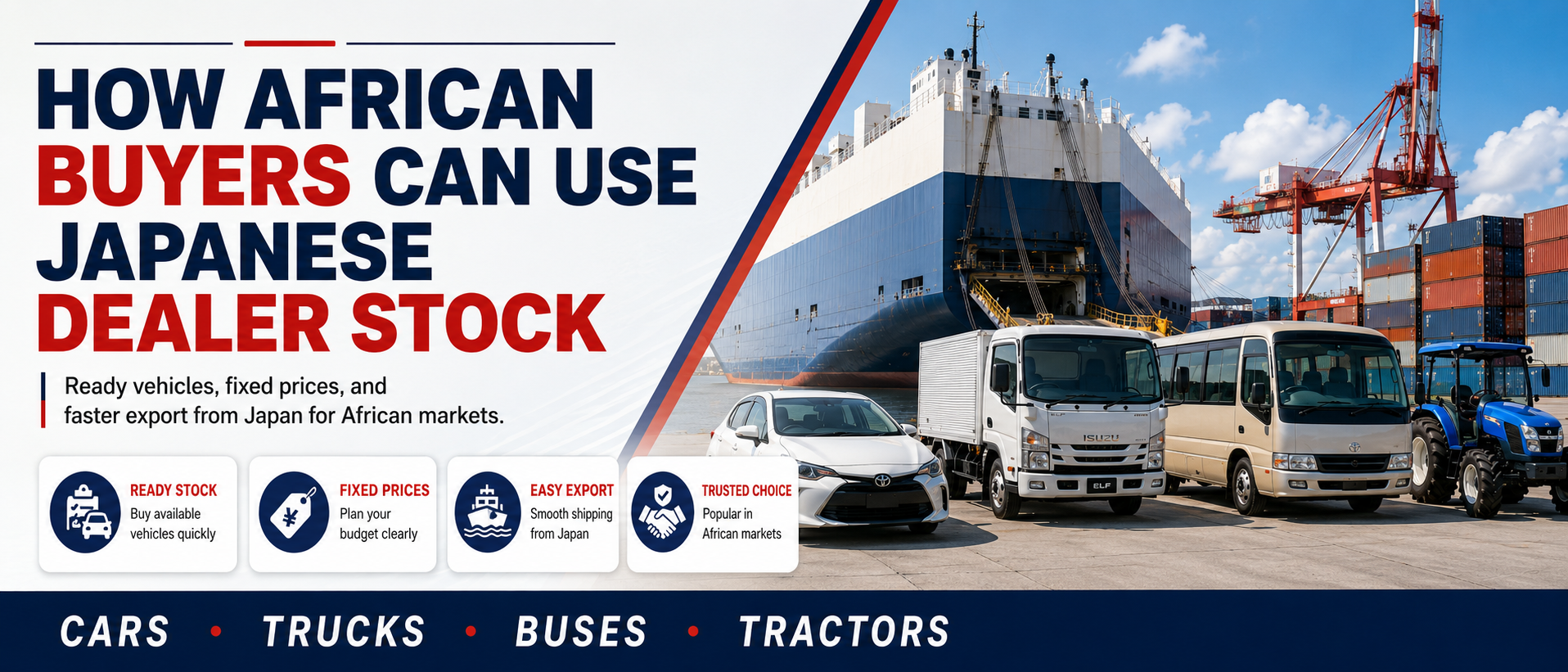
How African Buyers Can Use Japanese Dealer Stock
How African Buyers Can Use Japanese Dealer Stock is an important topic for importers, dealers, companies, and business buyers who want to buy used vehicles from Japan. Japanese dealer stock vehicles are already available for direct purchase. They usually have fixed prices, clear availability, and a faster buying process than auction vehicles.
Across Africa, many buyers need reliable cars, trucks, buses, vans, tractors, and machinery for daily business. Used vehicles from Japan are popular because they are practical, durable, and often easy to maintain. Dealer stock helps buyers find ready-to-buy units without waiting for auction bidding results.
For buyers in countries such as Kenya, Tanzania, Uganda, Zambia, Malawi, Mozambique, Zimbabwe, Ghana, and other African markets, speed and trust are very important. Dealer stock gives buyers a simpler way to compare vehicles, plan costs, and prepare for export from Japan.
1. Start with Vehicles That Match African Market Needs
The first step for African buyers is to choose vehicles that match local demand. A vehicle should not be selected only because it looks cheap. It should match road conditions, customer needs, fuel availability, parts supply, and import rules in the destination country.
Passenger cars are popular in many African markets for daily transport, taxi service, company use, and resale. Compact cars, sedans, SUVs, wagons, and hybrids may all have demand depending on the country and customer group.
Trucks are also very important. Many African buyers need used trucks for construction, logistics, farming, delivery, mining support, and general business. Light-duty trucks can be useful for city delivery and small businesses. Medium and heavy-duty trucks can support larger cargo and tougher work.
Buses and vans are useful for schools, churches, hotels, companies, tourism, and public transport. Buyers should check seat count, air conditioning, interior condition, and road suitability before choosing a bus or van.
Tractors and machinery are also valuable in farming areas. Many farmers and agricultural businesses need simple, strong machines that can work every day. Japanese used tractors can be useful when they match local field conditions and maintenance needs.
African buyers can begin by checking available Japanese dealer stock vehicles and comparing ready-to-buy units that fit their country and business purpose.
2. Use Fixed Prices to Plan the Total Import Cost
One of the biggest benefits of dealer stock is fixed pricing. For African buyers, clear pricing is very important because the vehicle price is only one part of the total import cost.
Buyers should also calculate export preparation, inland transport in Japan, shipping cost, port charges, customs duty, clearing fees, inspection, local registration, and possible repairs after arrival. These costs can change depending on the vehicle type and destination port.
Dealer stock helps because the vehicle price is usually shown in advance. This makes it easier for buyers to calculate the total budget before purchase. For resale businesses, this also helps with profit planning.
For example, a dealer in Kenya may need to know the full cost before setting a resale price. A company in Zambia may need approval before buying a truck. A farmer in Uganda may need to compare the cost of different tractors before choosing one. Fixed pricing supports these decisions.
Auction vehicles can offer many choices, but the final price is not always clear before bidding ends. The buyer may win or lose the bid, and the price can rise because of competition. Dealer stock is simpler because the buyer can confirm the price before moving forward.
This price clarity gives African buyers more control, especially when exchange rates, shipping costs, and local import fees must be considered.
3. Check Condition, Documents, and Export Readiness
Before buying from Japan, African buyers should check vehicle condition carefully. Since many buyers cannot inspect the vehicle in person, photos and clear information are very important.
For cars, buyers should check mileage, engine size, transmission, fuel type, body condition, interior condition, tires, and visible damage. Popular models with good condition can be easier to resell and maintain.
For trucks, buyers should check engine condition, chassis, payload, body type, tires, suspension, and work purpose. A truck for construction may need different checks from a truck for delivery or long-distance cargo.
For buses, buyers should check seating capacity, air conditioning, doors, windows, interior condition, and passenger comfort. These points are important for transport businesses, schools, and hotels.
For tractors, buyers should check operating hours, horsepower, tire condition, hydraulics, PTO, attachments, and engine condition. In rural African markets, simple and repairable machines can be more useful than machines with too many electronic systems.
Documents are also important. Buyers should confirm what export documents are prepared and what documents are needed for customs clearance in their country. Import rules can differ by country, so buyers should check local requirements before purchase.
For buyers who want to understand dealer stock, auctions, and direct buying from Japan in more detail, the Japanese dealer stock vehicles guide is a helpful resource.
4. Work with a Trusted Exporter for Smooth Shipping
Working with a trusted Japanese exporter is very important for African buyers. Buying a used vehicle from Japan is not only about selecting a unit. Buyers also need support with quotations, invoices, payment steps, documents, shipping, and communication.
A professional exporter can help confirm vehicle availability, explain condition, check export timing, and guide the buyer through the process. This is especially useful for first-time importers and buyers who are purchasing for business.
Shipping routes to Africa may use different ports depending on the destination country. Some buyers use ports such as Mombasa, Dar es Salaam, Durban, Maputo, Walvis Bay, or other regional ports. The best port depends on the buyer’s country, inland transport, and import process.
Vehicles may be shipped by RoRo vessel or container depending on the vehicle type, route, and destination. Cars, trucks, buses, vans, tractors, and machinery may need different shipping arrangements. A trusted exporter can help explain the best option.
Dealer stock can support faster shipping because the vehicles are already available. Once the buyer confirms the vehicle and completes payment, export preparation can often begin quickly. This reduces delays at the sourcing stage.
African buyers who want ready-to-buy vehicles can browse used vehicles from Japan dealer stock and send inquiries for units that match their market, budget, and business needs.
Conclusion
How African Buyers Can Use Japanese Dealer Stock can be summarized in a simple way. Buyers should choose vehicles that match local demand, use fixed prices to plan total cost, check condition and documents, and work with a trusted exporter.
Dealer stock is useful because it offers speed, trust, and simplicity. Vehicles are already available, prices are usually fixed, and buyers can move forward without waiting for auction bidding results.
This system is helpful for many African buyers, including importers, dealers, companies, transport operators, farmers, and first-time buyers. It supports many vehicle types, including cars, trucks, buses, vans, tractors, and machinery.
EVERY helps overseas buyers source suitable used vehicles from Japan and supports the export process from inquiry to shipping. For African buyers who want clear pricing, ready availability, and reliable support, Japanese dealer stock is a strong place to start.


Browse Reliable Used Trucks & Buses from Japan
Carefully selected vehicles ready for export worldwide
Search 100,000+ Dealer Stock Vehicles from Japan
Access a wide selection of vehicles from Japanese dealers nationwide. Updated daily.