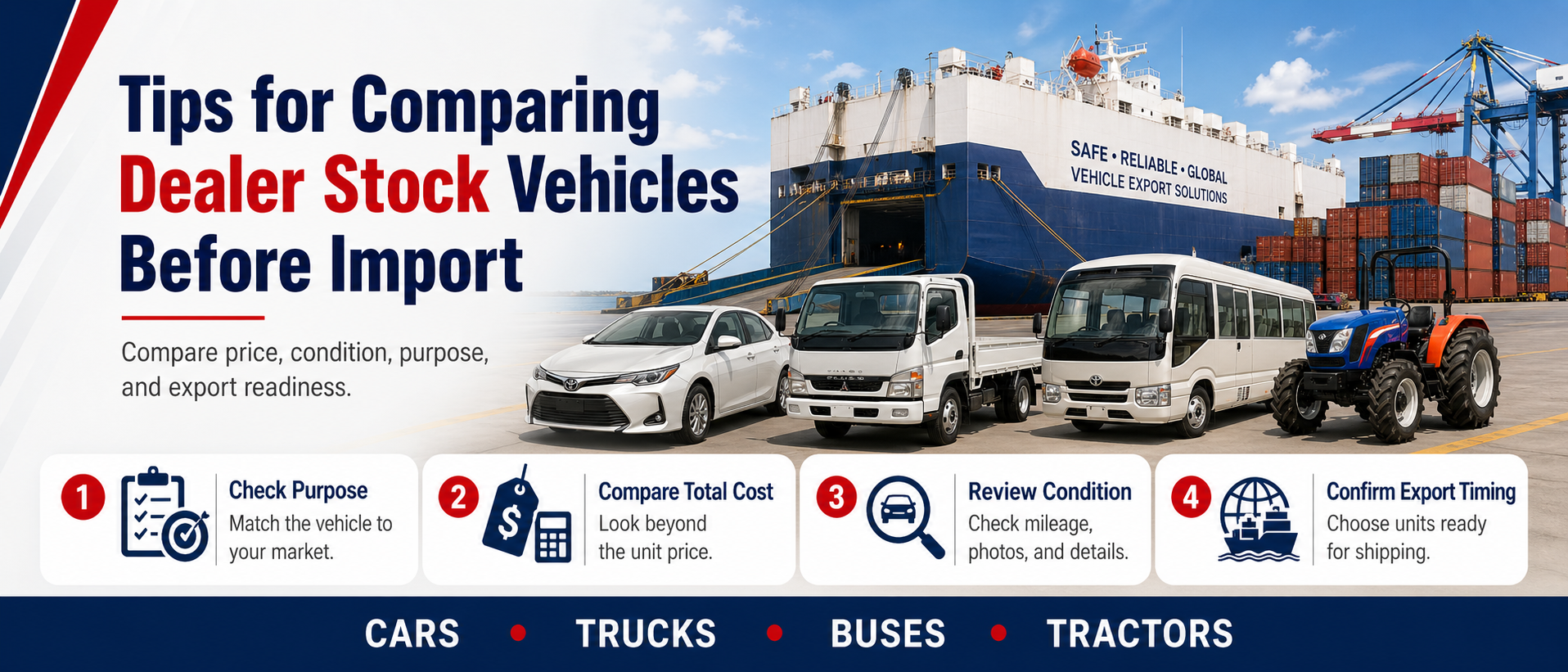
Tips for Comparing Dealer Stock Vehicles Before Import
Tips for Comparing Dealer Stock Vehicles Before Import are important for overseas buyers who want to buy used vehicles from Japan with confidence. Dealer stock vehicles are already available for direct purchase. They usually have fixed prices, clear availability, and a faster buying process than auction vehicles.
For importers, used car dealers, business owners, and individual buyers, comparing vehicles before import is very important. A low price is not always the best choice. Buyers should also check condition, mileage, purpose, shipping cost, parts availability, and local market demand.
Dealer stock makes this comparison easier because buyers can check ready-to-buy vehicles before making a decision. This is useful for buyers in Africa, the Caribbean, Asia, Oceania, and other export markets. With the right comparison, buyers can choose cars, trucks, buses, vans, tractors, and machinery that match their business needs.
1. Compare the Vehicle Purpose First
The first step is to compare each vehicle based on purpose. Before looking at the price, buyers should ask one simple question: What will this vehicle be used for?
A passenger car may be used for resale, taxi service, daily transport, or company use. A used truck may be needed for delivery, construction, farming, or logistics. A bus may be used for school transport, hotel service, tourism, or public passenger transport. A tractor may be needed for farm work or rural business.
When buyers understand the purpose clearly, it becomes easier to compare vehicles. For example, a cheap car may not be good for resale if the model is not popular in the local market. A truck with a large body may not be suitable for narrow city roads. A bus with many seats may be useful for transport business, but it may also have higher import costs.
Buyers should also think about local road conditions. Some markets need strong suspension, higher ground clearance, diesel engines, or simple mechanical systems. In rural areas, easy maintenance and spare parts availability may be more important than luxury features.
When comparing Japanese dealer stock vehicles, buyers should choose units that fit the real use in their country. This helps reduce future problems and supports better business results after import.
2. Compare Price, Total Cost, and Fixed Pricing
Price is important, but buyers should not compare only the vehicle price. The real cost of importing a used vehicle from Japan includes many parts. Buyers should think about the vehicle price, export preparation, inland transport in Japan, shipping cost, port charges, customs duty, local registration, and possible repairs after arrival.
Dealer stock is useful because the vehicle price is usually fixed. This makes budget planning easier. Buyers can see the listed price, ask about export and shipping costs, and prepare a more accurate total estimate before buying.
This is different from auction vehicles. In an auction, the final price can change because of bidding. A buyer may plan one budget, but the final price may become higher. Sometimes the buyer may not win the vehicle at all. Dealer stock helps reduce this uncertainty.
When comparing two or more dealer stock vehicles, buyers should check which unit gives the best total value. A cheaper vehicle may need more repair. A slightly more expensive vehicle may have lower mileage, better condition, or better resale value. The best option is not always the lowest price.
For business buyers, profit planning is also important. A dealer should compare expected resale price in the local market. A company should compare operating cost and expected working life. A farmer should compare machine condition, attachments, and repair support.
Clear fixed pricing gives overseas buyers more control. It helps them make faster decisions and prepare for export with less confusion.
3. Compare Condition, Mileage, and Photos Carefully
Vehicle condition is one of the most important points before import. Since many overseas buyers cannot inspect the vehicle in person, they should check photos and available details carefully.
For passenger cars, buyers should look at exterior condition, interior condition, mileage, engine type, transmission, tires, and visible damage. For cars used for resale, clean appearance and popular specifications are important.
For trucks, buyers should check the engine, chassis, body type, loading capacity, tires, suspension, and cabin condition. A truck may look good outside, but buyers should also think about work use. A delivery truck, dump truck, crane truck, and flat body truck all have different points to check.
For buses and vans, buyers should check seating capacity, interior space, air conditioning, doors, windows, and passenger comfort. These points are important for transport companies, schools, hotels, and tourism businesses.
For tractors and machinery, buyers should check operating hours, tires, attachments, hydraulic condition, engine condition, and working purpose. Strong and simple machines can be very useful in farming markets.
Photos are helpful, but buyers should also ask questions. Good questions include: Is the vehicle still available? Are there any major damages? What is the engine condition? Are there repair points? What documents are available? Can the vehicle be prepared for export soon?
For more details about comparing dealer stock and buying direct from Japan, the Japanese dealer stock vehicles guide is a useful resource for overseas buyers.
4. Compare Export Readiness and Shipping Timing
Export readiness is another key point when comparing dealer stock vehicles before import. Some buyers need vehicles quickly. Others can wait for the right shipping schedule. Understanding timing helps buyers choose better.
One advantage of dealer stock is speed. Since the vehicle is already available, the export process can often start soon after purchase confirmation and payment. This is useful for dealers who need resale stock, companies that need vehicles for business, and buyers who want to avoid long waiting times.
Buyers should ask whether the vehicle can be prepared for export quickly. They should also ask about document preparation, inland transport, port movement, and shipping options. The actual timing depends on the vehicle location, destination port, shipping route, and vessel schedule.
Shipping method is also important. Many cars, trucks, and buses are shipped by RoRo vessel. Some vehicles, tractors, and machinery may also be shipped by container depending on the route and size. Buyers should confirm which method is suitable for their vehicle and destination.
Import rules in the destination country must also be checked before purchase. Age limits, inspection rules, emission rules, steering position, and document requirements can differ by country. A vehicle that is suitable for one market may not be allowed in another market.
When buyers compare used vehicles from Japan dealer stock, they should consider not only price and condition, but also export speed and import rules. This helps avoid delays and unexpected costs.
Conclusion
Tips for Comparing Dealer Stock Vehicles Before Import can be summarized in a simple way. Buyers should compare purpose, total cost, condition, and export readiness before making a purchase decision.
Dealer stock is useful because it offers speed, trust, and simplicity. Vehicles are already available, prices are usually fixed, and buyers can move forward without waiting for auction bidding results.
For overseas buyers, careful comparison can reduce risk and improve business results. Importers can choose better resale stock. Companies can find suitable trucks, buses, and vans for operations. Farmers can find tractors and machinery that match their work needs.
EVERY supports overseas buyers by helping them compare suitable vehicles from Japan and understand the export process. For buyers who want a clear and practical way to import used vehicles from Japan, dealer stock is a strong place to start.


Browse Reliable Used Trucks & Buses from Japan
Carefully selected vehicles ready for export worldwide
Search 100,000+ Dealer Stock Vehicles from Japan
Access a wide selection of vehicles from Japanese dealers nationwide. Updated daily.